Steel-Frame Enclosed Trailers Explained.

A steel-frame enclosed trailer is the market's value backbone. It's stronger per dollar than aluminum, repairable at any weld shop, and heavier, and rust is what you fight over its lifetime. Buy steel for budget builds, occasional use, and dry climates, and buy it smart, because the coating quality and the floor-to-wall junction decide how the rust fight goes. Inspect where the tubes meet the floor. That's where these trailers age first.
What a steel-frame cargo trailer is
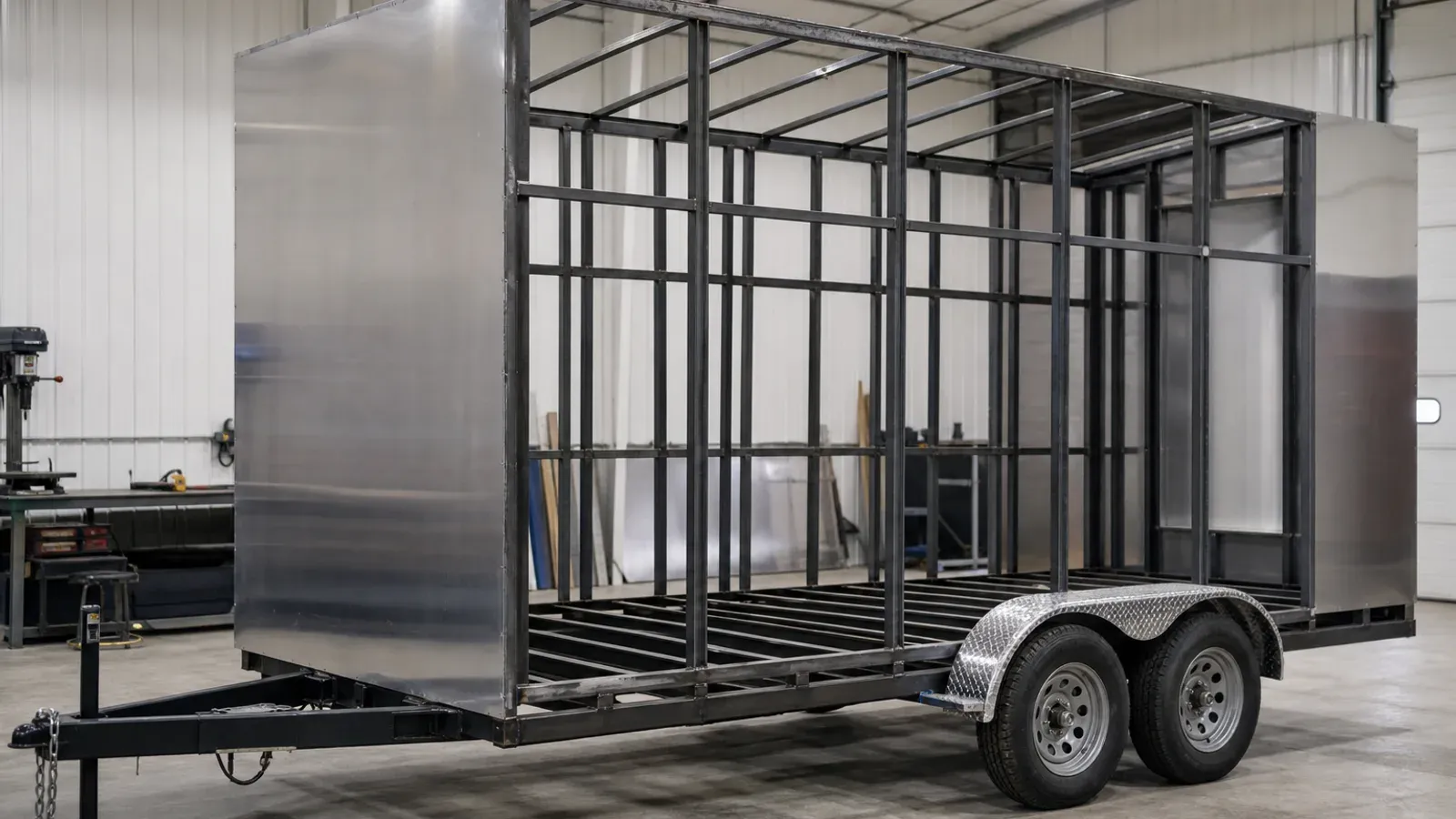
Steel frame means the trailer's skeleton, the main rails, crossmembers, wall posts, and roof bows, is welded steel tube, skinned in aluminum sheet like nearly every enclosed trailer regardless of frame. The skin confuses buyers, because an all-white aluminum exterior tells you nothing. The frame material lives underneath, on the spec sheet, and in the price.
Steel's case is strength per dollar, and it isn't close. Steel tube carries more load, resists impact better, and welds cheaper than an aluminum section of the same cost, which is why steel frames own the entry and middle of the enclosed market and why the same box in aluminum quotes 30 to 50 percent higher. Repairability adds to the case. Any weld shop in any town fixes steel, while aluminum welding is a specialty visit.
Steel's cost is weight and corrosion. The frame runs 15 to 25 percent heavier than the aluminum equivalent, paid in payload and fuel every mile. And steel oxidizes, slowly and forever, starting wherever the coating fails and moisture lingers, which on an enclosed trailer means the specific places this page will point out. The rust fight is winnable for decades with a good factory coating and an owner who looks underneath twice a year, and lost in five years with neither.
The buyer profile is honest value. Occasional haulers, dry-climate owners, trades on budgets, and anyone whose spreadsheet says the aluminum premium would buy more trailer spent elsewhere. That's most of the market, which is why most of the market rides on steel.
Tubes, coatings, and where rust actually starts
The frame recipe is square and rectangular tube. Main rails and crossmembers in heavier section, wall posts and roof bows lighter, all MIG-welded into the cage the skin hangs on. Quality shows in the sections and spacing: wall posts on 16-inch centers rather than 24, crossmembers under the floor on 16 rather than 24, and a tube gauge the spec sheet states plainly. The guide's construction section covers the walls. This page watches the metal.
Coatings decide the whole corrosion fight. Rattle-can black over mill-scale tube is the economy tier, and it shows by year three. Quality builders prep and coat, and the ladder runs from paint to powder coat to hot-dip or pre-galvanized treatment at the top, with undercoating on the exposed belly as the working standard. Ask the coating question specifically. Builders proud of their process answer in detail, and the ones who just say "it's painted" have told you plenty.
Rust starts where water sits, and on an enclosed trailer that's a known map. The floor-to-wall junction goes first, where the posts land on the frame and both road spray and interior washouts drain. Next is the rear frame around the door, with its hardware holes and constant flexing. Then the tongue and coupler area, stone-blasted bare. And any spot where the skin's fasteners pierced the tube, each screw a tiny coating breach. Inspection means a flashlight underneath at those points, twice a year, with a wire brush and cold-galvanizing spray. That ten-dollar habit adds a decade.
Salt states change the math, not the metal. Road brine finds every coating flaw at industrial speed, and steel trailers wintered on treated roads age triple-time underneath. If you're a northern or coastal owner putting on real miles, read the aluminum page and the full comparison before defaulting to steel's price. Steel buyers there should budget the annual underside wash and recoat like insurance, because that's what it is.
Steel-frame sizes and the weight ledger
| Class | Typical GVWR | Steel Empty Weight | Typical Payload |
|---|---|---|---|
| 6x10 single axle | 2,990 lb | 1,250 to 1,450 lb | 1,550 to 1,750 lb |
| 6x12 tandem | 7,000 lb | 1,800 to 2,100 lb | 4,900 to 5,200 lb |
| 7x16 tandem | 7,000 lb | 2,400 to 2,800 lb | 4,200 to 4,600 lb |
| 8.5x20 tandem | 9,900 lb | 3,100 to 3,600 lb | 6,300 to 6,800 lb |
The weight column is steel's tax made visible. Against aluminum equivalents running 15 to 25 percent lighter, the steel box gives up 300 to 700 pounds of payload in the common classes, and gives it up again in fuel across every loaded and empty mile. Occasional haulers shrug. High-mileage operators do the multiplication.
Class math otherwise runs the guide's standard table: GVWR honesty, half-ton territory through the 7-wide classes loaded, three-quarter-ton at 8.5-wide, and the same tall-box wind manners no matter what the frame is made of. One small mercy: steel's extra pounds sit low in the frame, so they don't worsen the sail.
Where steel wins and loses
Here's the rule. Steel is the right frame for most buyers, bought with eyes open, a real coating spec, and a semi-annual look underneath. It's the wrong frame for salt-state high-milers, who should price aluminum's premium against steel's shortened service life and will usually find the premium fair.
Steel-frame FAQ
How do I know if a trailer is steel or aluminum framed?
Check the spec sheet, the price, and a magnet on the frame at the rear door or under the floor. The exterior skin is aluminum either way and tells you nothing.
How long does a steel-frame trailer last?
Decades in dry climates with a decent coating and basic attention, and as few as five to eight hard years wintered on salted roads without either. Coating and climate set the clock.
Where does rust start?
The floor-to-wall junctions, the rear door frame, the tongue, and the fastener penetrations, anywhere water sits against a coating breach. That's your flashlight map.
Is steel stronger than aluminum?
Per dollar, decisively. Per pound, aluminum's engineering closes the gap. A quality build in either material carries its rating, so the difference is what you pay and what you weigh.
How much heavier is steel?
Typically 15 to 25 percent on the frame, or 300 to 700 pounds on common classes, subtracted from payload and paid in fuel.
What maintenance does the frame need?
A wash underneath after winter or coastal exposure, a semi-annual flashlight inspection at the junction points, and wire-brush plus cold-galvanizing spray on any bloom. Ten dollars a year, a decade of difference.