Gooseneck Dump Configurations Explained.

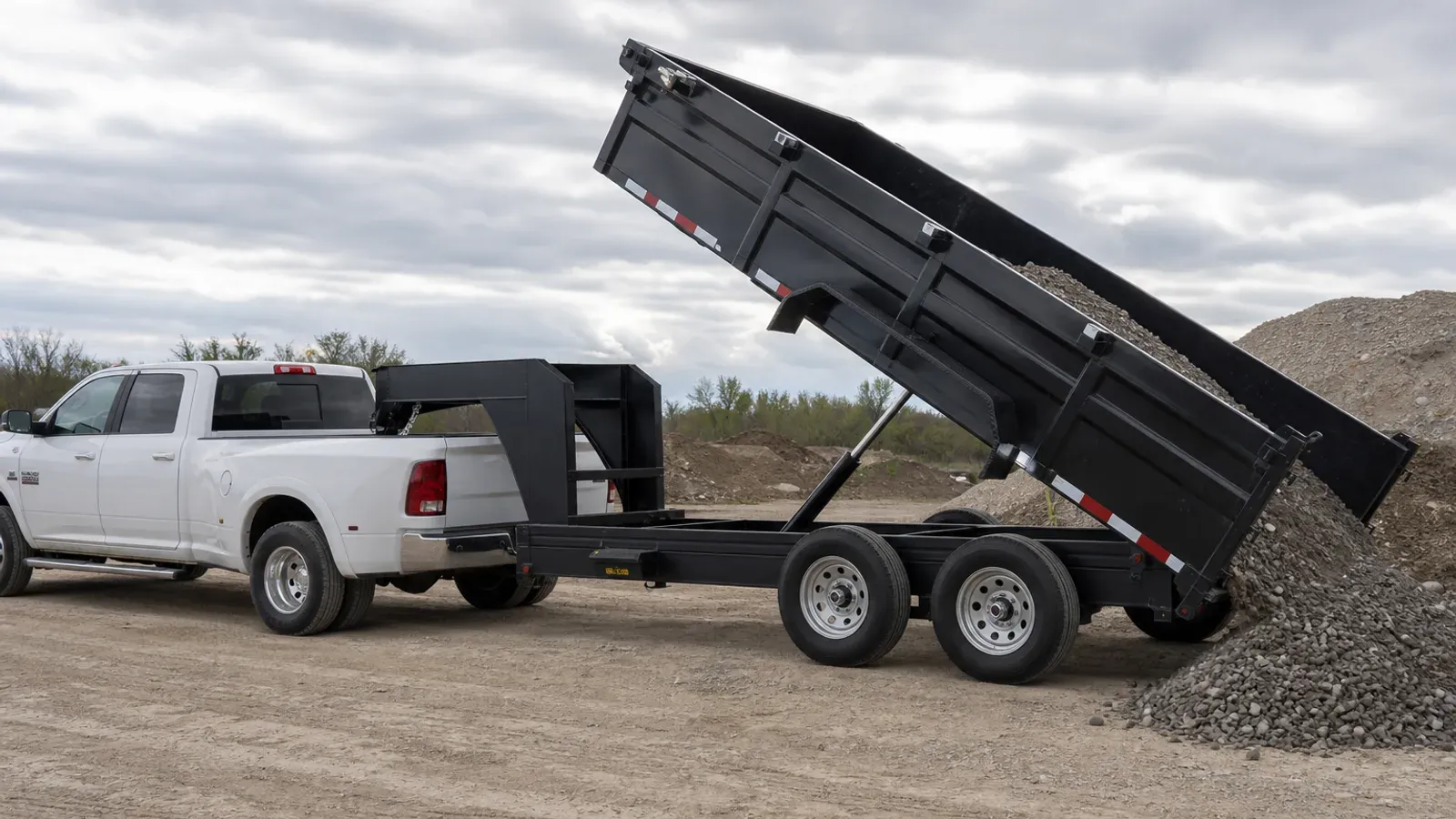
The dump is the one gooseneck that unloads itself, a hydraulic box on the neck that carries 11,000 to 16,000 pounds of material a trip. It's the family's specialist, unbeatable for loose material and wrong for nearly everything the other decks haul. This page is about where it fits among its siblings. The deep dump coverage lives on the dump side at /trailers/dump-trailer/gooseneck/.
The dump's seat at the gooseneck table
Every gooseneck configuration answers one question differently, what rides behind the neck. The flatbed puts a low general deck back there, the deckover a full-width freight platform, and the equipment build a deck for machines. The dump answers with a hydraulic box that empties itself, which makes it the family's only self-unloading trailer and its purest specialist.
That specialist label cuts both ways, and it's the key to buying one. A gooseneck dump moves gravel, dirt, and debris at roughly double a bumper-pull dump's honest payload, but it does almost nothing else well. The box walls shut out the machines, pallets, and long material every other configuration is built for. That's why fleets pair it with a deck trailer. Walk into an excavation yard and you'll usually find a gooseneck dump and an equipment gooseneck sharing one dually.
The dump-side guide carries the deep coverage: lift systems, box specs, class tables, and the capacity math against bumper-pull dumps. Here we handle the other comparison, the dump against the siblings it shares a neck with, which is the question shoppers actually stand in the yard asking.
Who buys one? Excavation and grading crews that move volume daily, demolition outfits, ag operations hauling feed and fill, and the material half of any dirt-work fleet. If your loads are loose and heavy and the trips never stop, the family has exactly one right answer, and this is it.
What the neck changes about dumping
The neck solves the loaded dump's oldest problems. Dense material is the heaviest cargo per foot in towing, and the stability that the neck buys, pin weight over the axle and sway resistance from geometry, matters most under exactly these loads. A bumper-pull dump at its 14K ceiling tows like hard work. A gooseneck dump at 16K tows calmer and carries more. Tight turning pays off daily too. Dump sites and material yards are one long backing exercise, and the neck's pivot puts a 16-foot box where bumper geometry never could.
The pin math keeps its usual shape, with one dump-specific wrinkle. Fifteen to 25 percent of loaded weight rides the pin, but a dump's load moves, sliding rearward as you climb material into the box and forward under braking. Good builds set the box slightly forward-biased to account for it, and tongue weight turns into a loading habit, where you place each bucket front to back on every load.
Dumping from the neck adds one habit worth learning. Raising a loaded box shifts mass up and to the rear, so the truck's back end unloads slightly as the trailer's rear plants. Level ground under the whole rig, truck included, is a rule the family's other configurations never have to think about. The dump-side guide covers the lift systems that do the work, almost always scissor mechanisms at this weight.
Everything else is family standard: tandem 8K and 10K axles, brakes all around, dual jacks, a one-ton truck, and the CDL math that working rigs at this tier run into by default.
Where the dump sits in the family's range
| Configuration | Typical GVWR | Typical Payload | The Job |
|---|---|---|---|
| Gooseneck dump, 7x14 to 8x16 | 15,900 to 22,000 lb | 11,000 to 16,000 lb | Loose material, self-unloading |
| Gooseneck flatbed | 14,000 to 25,900 lb | 9,800 to 18,800 lb | General, hay, mixed freight |
| Gooseneck deckover | 20,000 to 30,000 lb | 13,600 to 21,500 lb | Wide freight, pallets |
| Gooseneck equipment | 14,000 to 30,000 lb | 9,500 to 22,500 lb | Machines |
The table lays out the whole family in one view, and the dump's row is narrow on purpose. Its payload keeps up with every sibling, but its cargo list doesn't, and the payload math hits it hardest, since hydraulics and box walls eat 6,000 to 7,400 empty pounds on the working classes. What the row can't show is labor. Self-unloading in thirty seconds beats an hour of machine time per load, and that's the whole reason to buy one and why material fleets never regret it.
The class details, box sizes, lift systems, and the bumper-pull comparison live on the dump-side guide, and how to handle material density lives on the gravel and dirt page. Both are one click away.
The dump against its siblings
Here's the family-level buying rule. If loose material is a line of business, the dump belongs in the fleet, full stop. The only real question is whether it's your first trailer or your second, and the next 90 days of work will tell you.
Gooseneck dump FAQ
Gooseneck dump or gooseneck flatbed first?
Whichever cargo earns more this quarter. Steady material volume points to the dump, mixed and machine work points to a deck, and most dirt fleets own both within two seasons.
How much more does it haul than a bumper-pull dump?
Roughly double the honest payload, 11,000 to 16,000 pounds against a 14K bumper-pull's 8,500 to 10,300. The dump-side guide runs the full math.
Can it haul a machine in the box?
A compact machine can go in through a ramp-gate option, within the bed's rating, but treat it as a convenience, not a plan. Machine work belongs on the equipment configuration.
What truck does it need?
A one-ton, a dually at the heavy end, sized by payload against pin weight like every other trailer in the family. The dump's shifting load is a good reason to leave yourself margin.
Do I need a CDL?
Working combinations here cross 26,000 combined pounds routinely in commercial use. Federal and state rules have the details, but plan on yes.
Where's the detailed dump coverage?
The dump family's own pages, the guide and the gooseneck dump page, cover lift systems, box specs, and class tables in full.