Landscape Trailers. The Complete Guide.

A landscape trailer is a utility trailer built for the green industry, a reinforced ramp gate that survives daily mower traffic, taller sides for bulk material, and racks for trimmers, blowers, and tools. Buy by mower count and deck length, gate rating, and how much of your shop needs to ride along. The 6.5x14 and 7x16 tandems are the industry's workhorses.
What a landscape trailer actually is
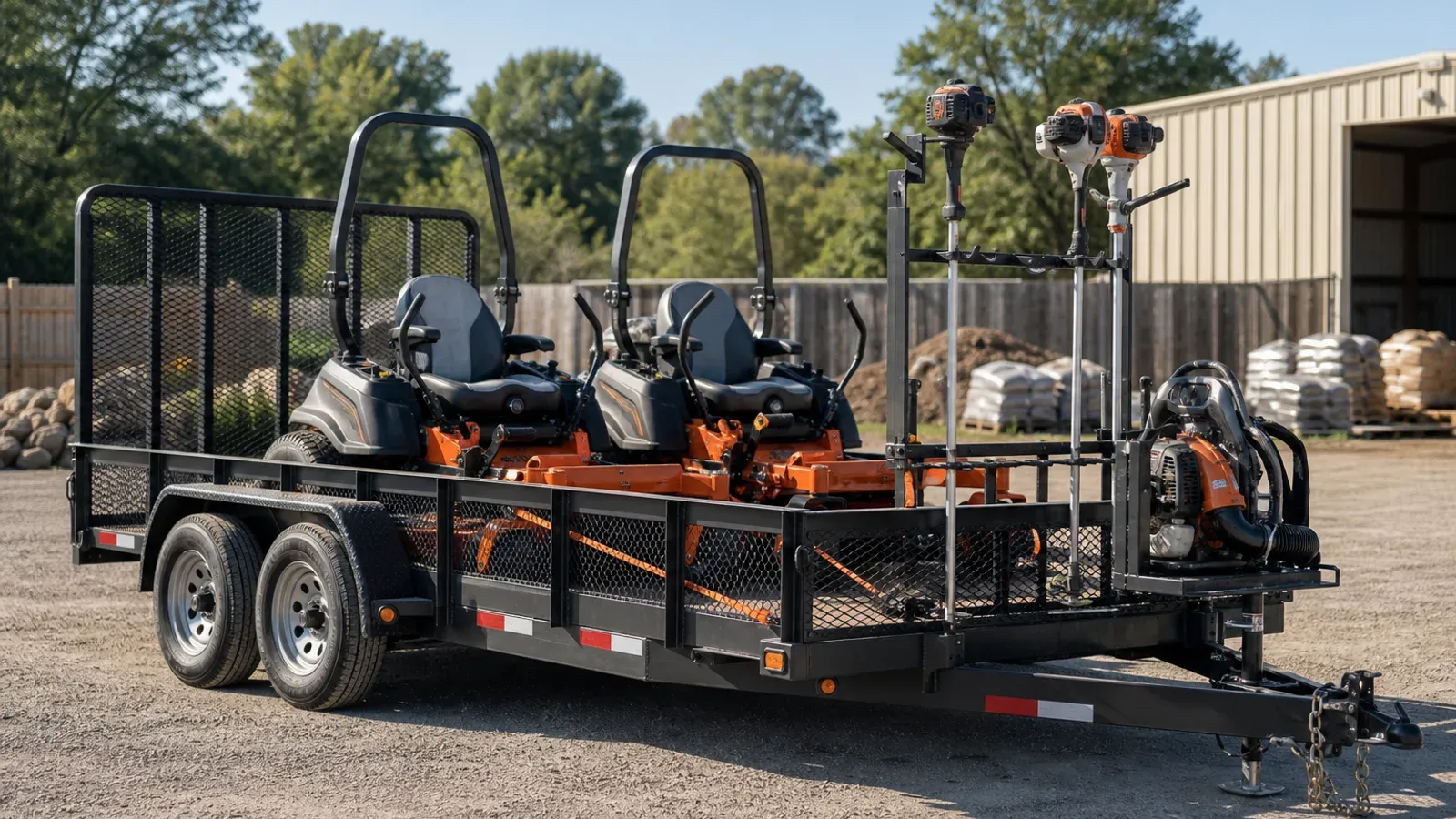
A landscape trailer is what happens when a utility trailer takes a full-time job. Same open deck and sides, same rear gate, but every piece upgraded for a crew that loads and unloads twenty times a day. The gate becomes a reinforced ramp rated for a zero-turn hitting it at speed. The sides grow taller for mulch and material. Racks appear for trimmers, blowers, and water coolers. The trailer stops being storage and becomes the crew's rolling shop floor.
The distinction from a plain utility trailer is duty and outfit, not bones, and the utility versus landscape comparison draws the line honestly. A homeowner with a mower buys a utility trailer. A crew running two zero-turns, three trimmers, and a debris load buys the landscape configuration, because every upgrade maps to a daily task. The industry knows this, which is why "landscape package" appears on every builder's order sheet.
The cargo mix defines the build. Mowers dominate, zero-turns and stand-ons rolling on and off all day, which drives gate rating and deck length. Loose material rides between jobs, mulch, soil, and debris, which drives side height. And the hand-tool fleet, trimmers, edgers, blowers, needs racks that secure against both bouncing and theft, because an open trailer full of equipment at a gas station is an honesty test the industry has repeatedly failed.
Who's buying. Landscapers and lawn businesses first and always, plus fencing crews, property managers, and anyone whose work is a daily loop of load, drive, unload, work, repeat. If that's the rhythm, this is the trailer, and the configuration decisions below are the whole game.
Gates, sides, and racks that earn their keep
The gate is the heart of the machine. A landscape gate is a full-width mesh ramp on a reinforced tube frame, hinged to drop and rated for equipment rolling over it hundreds of times a week. Gate rating is the spec that separates trade builds from homeowner builds, a zero-turn crossing a flimsy gate flexes it a little more each trip until one day the trip is literal. Spring-assist or torsion assists earn their cost in every operator's lower back, and the gated ramp configuration page covers the variations, including split gates and side-load options for tight routes.
Sides carry the material side of the business. Standard utility rails run 12 to 15 inches, landscape side-rail builds step to 2 feet, and high-side versions run 4 feet of solid or mesh wall for mulch volume. Taller sides mean more yards per trip and more wind surface per mile, and solid sides trap moisture against steel, so mesh uppers over solid lowers is the configuration that ages best. Removable side kits split the difference for mixed work.
Racks turn the trailer into the shop. Rack-equipped builds carry trimmer racks holding two or three machines locked and isolated from vibration, blower racks, cooler mounts, spool holders for trimmer line, and shovel-and-rake trees on the front rail or sides. Factory racks cost less than dealer add-ons and bolt to reinforced points, and lockable versions are not optional, see the gas-station honesty test above. Layout matters, racks on the curb side load faster on route, racks over the fenders waste no deck.
The floor takes the daily abuse. Treated wood decks handle mower traffic and repair plank by plank, and mesh floors shed clippings and water but transmit vibration to everything racked above. Most trade builds run wood decks with mesh gates, the combination that handles both machines and material without babying either.
Landscape trailer sizes and real payload
Landscape sizing is mower math. A 52-inch zero-turn needs about 6 feet of deck. Two of them need 12 to 13 feet plus walking room. The trade's standard answers, 6.5x14 and 7x16 tandems, exist because two machines plus gear is the standard crew. Payload stays honest the usual way, GVWR minus real empty weight, with racks and gates counting against it.
| Class | Typical GVWR | Typical Payload | Common Fit |
|---|---|---|---|
| 5x10 to 6x12 single axle | 2,990 to 3,500 lb | 2,000 to 2,600 lb | Solo operator, one mower |
| 6.5x14 tandem | 7,000 lb | 5,000 to 5,500 lb | Two-machine crew, the standard |
| 7x16 tandem | 7,000 lb | 4,900 to 5,400 lb | Two big machines plus gear |
| 7x18 to 8x20 heavy | 9,900 to 14,000 lb | 7,300 to 10,500 lb | Big crews, skid steer crossover |
Material math checks the same trailer differently. Mulch runs 400 to 800 pounds a cubic yard, topsoil and wet soil can pass 2,000, and high sides create volume the axles may not be rated to carry. A 7x16 with 4-foot sides holds roughly 10 yards of mulch by volume and far less than that of soil by weight. Sides are for volume loads, the GVWR is for everything, and the crew that learns this at a scale house learns it cheapest.
Trucks in this industry skew half-ton, and the standard 7K tandems loaded fit that reality, a half-ton handles the class with brakes and honest tongue weight. Crews stepping to the heavy classes, or adding a skid steer to the fleet, cross into three-quarter-ton math and should read the equipment guide before buying, the crossover point between a heavy landscape build and a light equipment trailer is real and worth pricing both ways.
Landscape trailer sub-types
The sub-types stack into one trailer, most trade builds carry all three in some measure. Configure by the business, material-heavy operations spend on sides, mower-heavy routes spend on the gate, and full-service crews rack everything. The order sheet is the business plan in steel.
The features that actually matter
The skip list, paint tiers and chrome on a trailer that hauls dirt for a living. The gate assist and the lockable racks are where option money returns daily, everything else is decoration on a mule.
Landscape trailer brands
Landscape packages come from the utility majors and a strong regional tier, and in the launch market the Texas builders punch hard on build-per-dollar.
Big Tex and PJ field deep landscape lines with the dealer coverage a route business needs. Sure-Trac's tube builds carry well here. Top Hat, Ranch King, and Texas Bragg, the Texas regional tier, build honest trade trailers at sharp prices with parts a local dealer actually stocks. Compare gate construction and rack packages first, they're the trade-specific specs, then let axle brands and frame details settle it.
What landscape trailers cost
Landscape pricing starts near the utility market and rises with the package. Solo-operator single-axles open low, the standard 6.5x14 and 7x16 tandem crew builds cluster in the mid four figures, and heavy or fully racked configurations climb from there. The package premium over a bare utility trailer is real and mostly justified, gates, sides, and racks bought factory beat the same parts added later on both price and mounting quality.
The padding pattern, freight, prep, doc fees, and the accessory sheet, with the category special being rack markup. Dealer-installed racks at double the catalog price is a proud industry tradition. Spec factory racks in the build or buy catalog racks and a drill, and never pay boutique prices for bent tube.
The trade buying mistake is under-speccing the gate to hit a price. The $400 saved on a light gate returns as a bent gate mid-season, a rental trailer, and a crew standing around, the most expensive $400 in the industry. Buy the gate for the heaviest machine plus a margin for the machine after it, businesses grow into their trailers.
Route businesses should also price the second trailer honestly. Many two-crew operations run better on two standard tandems than one heavy build, redundancy when one is down, and routes that split. The Price Guide's model-by-model numbers make that comparison concrete.
Know the fair price before you go
The free Price Guide lists current dealer and MSRP prices for hundreds of new trailer models, brand by brand, with a confidence label on every number.
Get the Price GuideLandscape trailer FAQ
What size landscape trailer does a crew need?
Count mower deck inches and add walking room. Two zero-turns land on the 6.5x14 or 7x16 tandem, the industry standards. One machine and gear fits a 6x12. Bigger crews and skid steer work step into the heavy classes.
What's the difference between a landscape and a utility trailer?
The trade package, a reinforced rated gate, taller sides, and racks, on the same utility bones. The comparison draws the line. Daily commercial use is what justifies the package.
How much mulch fits on a landscape trailer?
A 7x16 with 4-foot sides holds around 10 cubic yards by volume. Weight is the real limit, mulch runs 400 to 800 pounds a yard while soil can pass 2,000, so the same sides that swallow mulch will overload on dirt.
Can a half-ton tow a loaded landscape trailer?
The standard 7K tandems loaded, yes, with a brake controller and honest tongue weight. The heavy classes and skid steer crossover builds want three-quarter-ton math.
Do landscape trailers need brakes?
The tandem classes carry brakes on at least one axle by law nearly everywhere, both axles is the better spec for route miles. Singles depend on GVWR and state rules.
Mesh floor or wood floor?
Wood for mower traffic, repairability, and racked-equipment sanity. Mesh sheds clippings and water but vibrates everything above it. The trade standard is wood deck, mesh gate.
How do I keep equipment from being stolen off the trailer?
Lockable racks for the hand tools, cable or wheel locks for the machines, and hitch locks when parked. An unlocked open trailer at a gas stop is the industry's most reliable loss event.
Are the racks worth factory prices?
Factory racks bolt to reinforced points at reasonable cost. Dealer-installed rack markup is the thing to refuse, catalog racks and an hour with a drill match it for half.