Landscape Gate Ramps Explained.

The gate is the landscape trailer's most-used part and its most common point of failure. It's a full-width mesh ramp that drops and lifts more than twenty times a day under rolling mowers. The spec that matters is the rating under a moving zero-turn, backed by tube framing, real hinges, and a spring assist that saves you a thousand lifts a season. Buy the gate for your heaviest machine plus the next one you'll own, because a failed gate parks the whole route.
The part the route runs on
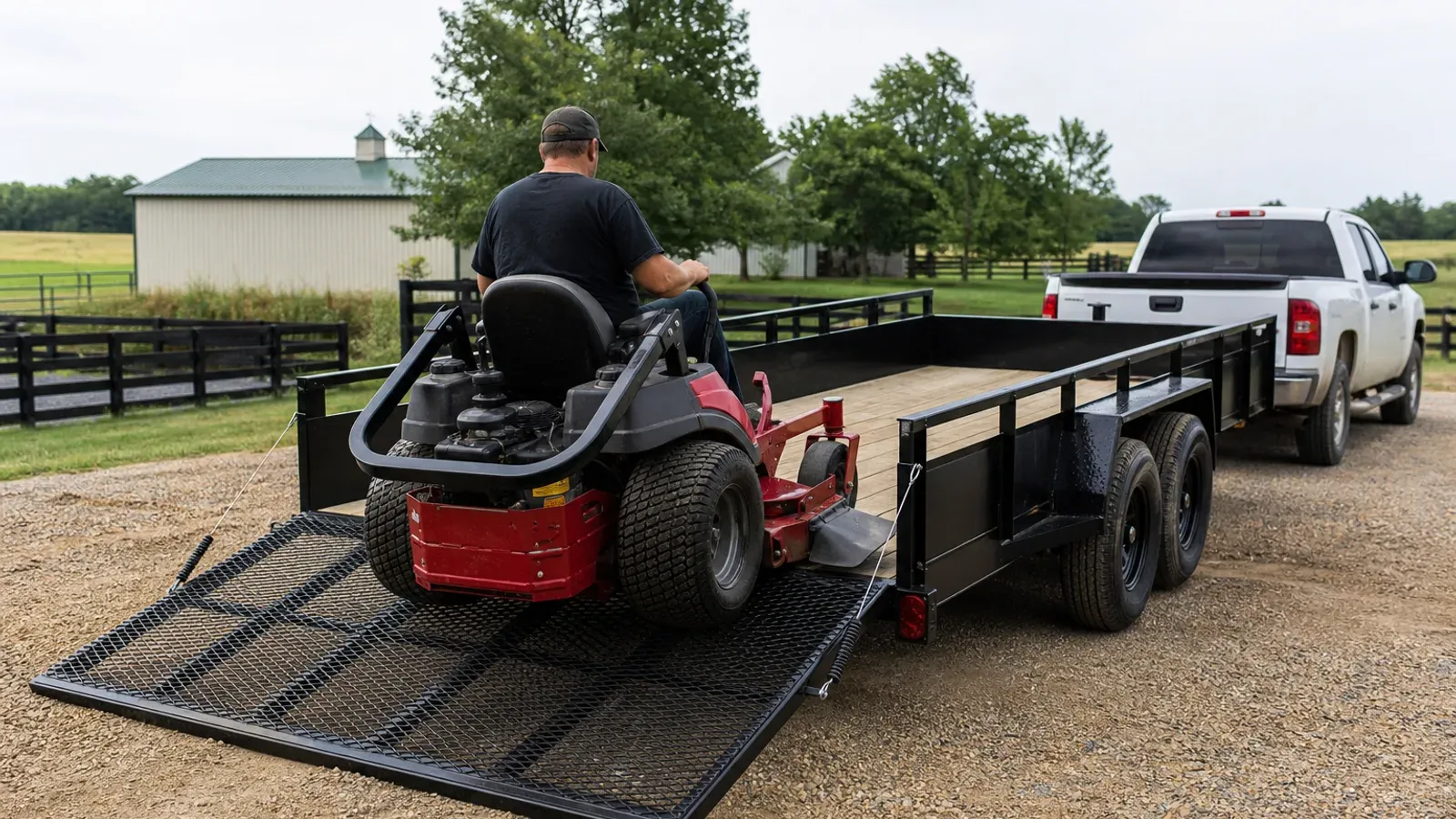
The gated ramp is the working heart of the landscape trailer, the full-width rear gate that drops into a ramp at every property and lifts closed at every departure. That's twenty-plus cycles a day, five days a week, with a 1,000-to-1,500-pound zero-turn rolling over it each direction. No other part works that hard, and no other failure shuts you down as completely, which is why the main guide calls the gate the one spec that separates trade builds from homeowner builds.
Gates fail by fatigue, not by one dramatic break. A light gate flexes under each crossing, and that flex slowly works the welds and the mesh loose. By mid-season it starts to sag, so it drags, then racks, then won't latch, exactly the slide every crew that saved $400 up front has watched happen. Trade-rated gates use tube framing, greaseable hinge pins, and ratings written for the machine at speed. You can see the difference in the steel and hear it in the crossing.
The variations exist to fit different routes. A standard full-width gate covers most work. Split gates halve the swing for tight streets and let half the gate handle light loads. Side-load gates on the curb rail let mowers board without the driver backing up to a drop zone, and dense-suburb crews price that convenience by the minute. Whichever gate the route calls for, the racks and side-rail heights build around it.
Ratings, assists, and the daily cycle
The rating is the honest line on the spec sheet. What matters is capacity under a moving machine, not a parked one, because a zero-turn hitting the ramp at loading speed concentrates force the static number never accounts for. Rate the gate past your heaviest machine with margin left for the next one, the same buy-for-growth rule the guide preaches. Tube framing holds that rating. An angle-iron perimeter gate just starts the countdown.
The assist is what saves your crew's backs. A 100-plus-pound gate lifted twenty times a day adds up to more than a thousand lifts a season per person. Spring and torsion assists cut the effective weight down to a one-hand close, and how well that assist is built, adjusted, and serviced is the difference between a gate crews thank you for and one they curse by June. Test it at the dealer with the gloves you'll actually wear.
The hinges and latches take the brunt of the cycle count. Look for greaseable hinge pins at real diameters, latch hardware that seats positively through a season of racking and wear, and a gate-to-deck transition smooth enough that the mower's arrival doesn't peen the deck boards. Those are the crossing details good builders sweat. Mesh choice finishes the picture. Tube-framed mesh sheds clippings and weather, and expanded metal at the premium tier suits crews whose machines chew through standard mesh.
Maintenance is short but not optional. Grease the hinges monthly in season, check the assist tension, and watch the latch alignment, since a latch that stops lining up is the first sign racking has started. Treat any early flex or sag as the warning it is. Gates fail on a schedule, and you can read that schedule early if you look.
Gate configurations by route
| Configuration | Best For | The Spec to Check |
|---|---|---|
| Full-width standard | Most routes | Rating under moving load, assist quality |
| Split gate | Tight streets, mixed loads | Both halves rated, center-post latch |
| Side-load gate | Dense-route curb loading | Curb-rail framing, deck transition |
| HD expanded-metal | Heavy machines, long seasons | Hinge pin diameter, tube gauge |
The gate rides on whatever chassis you picked from the guide's table, with the 6.5x14 and 7x16 tandems carrying full-width gates as the market default. The price gaps between configurations are small next to the failure they head off. Your machine list sets the rating and your route sets the format, and the entire gate argument in the utility-versus-landscape comparison comes down to getting this one option right.
The gate's ledger
Here's the buying rule, the same one the guide gives, applied to the part that proves it. Rate the gate for your heaviest machine plus the next one, get the assist, and let your streets pick the format. Five days a week, the gate is the trailer.
Gate ramp FAQ
What gate rating does a zero-turn need?
It needs to clear the machine's weight with margin to spare, rated under a moving load. Most full-size zero-turns want a 1,500-plus-pound moving rating, with room above that for growth.
Is the spring assist worth it?
More than a thousand lifts a season per crew member answers that before the price does. Dollar for dollar, it's the best ergonomics on the spec sheet.
What kills landscape gates?
Fatigue. Flex works the welds and mesh loose under daily crossings until sag, racking, and latch failure show up right on schedule. Tube framing and real ratings push that schedule out to a decade.
Split gate or full width?
Full width is the default. Go split where street swing is tight or half-gate loads are common, and make sure both halves are rated and the center latch is checked as closely as a hinge.
What's a side-load gate for?
Curb loading on dense routes, so mowers can board without the backing-up ritual. Route density decides whether it pays, and suburb crews usually say yes.
Can I upgrade a weak gate later?
You can, but replacements cost more than the factory option would have, and you'll accept some mounting compromises too. Buy the gate right the first time or pay for it twice.