Side-Rail Landscape Trailers Explained.

Side-rail height is the landscape trailer's material decision. Run 2-foot rails for mixed crew work and 4-foot walls for mulch and debris volume, and pick mesh over solid where drainage and wind matter. Walls add volume, not capacity, so soil can bury the axles while the box still looks half empty. Size the rails to the lightest bulk material you haul each week, and build them tough, because the crew is going to lean on them.
Walls sized to the route
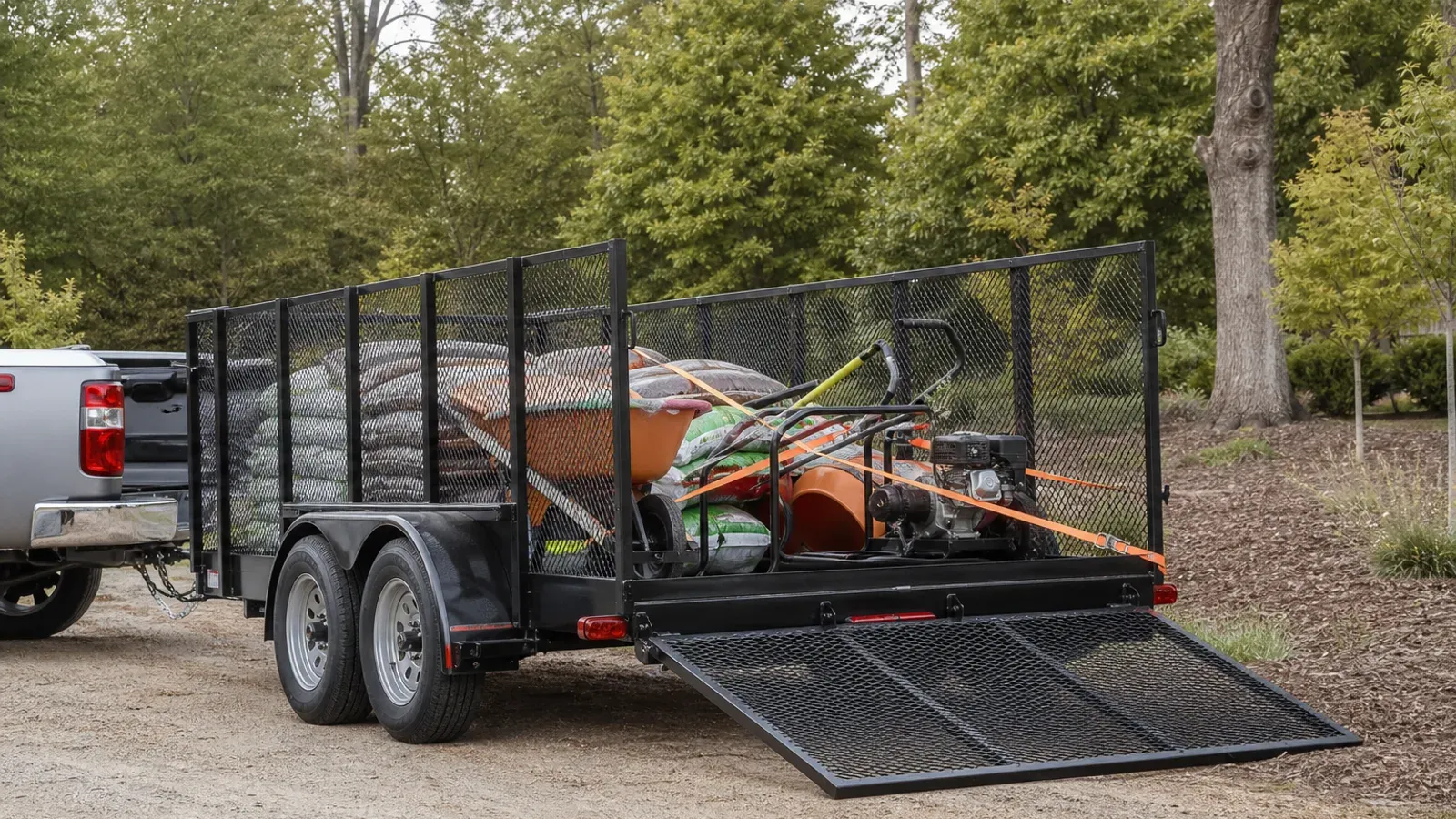
The side-rail build is the landscape trailer's answer to the material side of the route. It steps the walls up from the utility market's 12-to-15-inch rails to 24, 36, or 48 inches so they hold mulch, debris, brush, and clippings at the volumes crews actually bill for. It's the same wall logic the high-side utility uses, tuned to a trade crew's daily rhythm and bolted to the trade gate.
The height tiers line up with the kind of business you run. Two-foot rails suit a mixed crew, since the walls stay low enough to load over and still contain a moderate volume, which is why most route trailers wear them. Four-foot walls suit material-heavy work, cleanup crews, mulch installers, and the pile of debris that ends every landscape day, though they charge the usual wind and loading penalties tall walls always do. The middle heights split the difference.
The same physics warning shows up on every tall-wall guide here, and it matters most on landscape trailers, because these are the ones that meet soil. Walls give you volume, but GVWR is the real limit. Mulch fills the box and stays legal, but topsoil buries the 7K class at a yard and change. The crew that learns that at the scale house paid tuition the foreman should have covered.
Mesh, solid, and the build that survives crews
Wall construction follows the high-side playbook, just built tougher for trade use. You want uprights on tight centers, a top rail that survives the ten-thousandth shovel lean and the occasional crew member standing on it, and corners built stronger than bent sheet metal. Whether to run mesh or solid comes down to your material. Mesh sheds wind, drains green waste, and snags brush, while solid holds fines and clippings but catches every crosswind. The common compromise is solid lower panels under mesh uppers, which contains material where it presses and breathes where it doesn't.
Removable and drop-down panels earn their hardware on mixed routes, so the walls come off for the mower-and-pallet day and go back on for the cleanup leg. Latch quality is what separates a build that converts in minutes from one that needs a hammer. The gate ties in as the gated-ramp guide describes, with full-height rear containment that folds down into the ramp the mowers need, and the racks mount to reinforced wall points, never to the mesh.
Every tall build pays a wind tax. Empty solid walls catch gusts and truck wash, exactly as the high-side guide warns, mesh cuts that down, and even loaded, light cargo barely settles the box. Moderate speeds and tongue-weight discipline are the usual tall-wall habits, and they apply here too.
Rail heights and volume math
| Configuration | Volume, 7x16 Deck | Honest Cargo | The Wall's Job |
|---|---|---|---|
| 2-ft rails | ~7 cu yd | Mixed crew loads | Containment past the mowers |
| 3-ft walls | ~10.5 cu yd | Debris and clippings | The cleanup crew's box |
| 4-ft walls | ~14 cu yd | Mulch volume | Yards per trip as revenue |
To run the volume math, put the material-density table up against the payload subtraction. Mulch at 400 to 800 pounds a yard fills the 4-foot box while staying inside the 7K tandem's numbers, clippings and brush run out of room before they run out of weight, and soil ends the conversation fast. The chassis classes follow the landscape guide's table as is, with the walls adding steel against payload at every height.
The side-rail's ledger
The buying rule is short. Size the walls to the lightest bulk material you haul each week, spec mesh wherever the material allows it, and tape the soil rule to the dash. The box's volume is only a suggestion, and the GVWR never agreed to it.
Side-rail FAQ
What side height does a landscape crew need?
Two feet for mixed mower-and-material routes, and 4 feet where mulch and debris volume is the revenue. Your material mix decides, not the brochure.
Mesh or solid sides?
Mesh drains and sheds wind, solid holds fines, and a solid-lower, mesh-upper build does both. Lean mesh for green waste and solid bottoms for clippings.
How much mulch fits behind 4-foot walls?
A 7x16 holds about 14 yards by volume, though typical mulch hits the 7K class weight limit past 8. The density math gives you the honest numbers.
Can I haul soil in a side-rail trailer?
A yard and change against a 7K rating, and watch it closely. The walls don't change what the axles can carry, which is the whole warning here.
Are removable panels worth it?
On mixed routes, yes. You save minutes per conversion and get one trailer doing two jobs. Latch quality is the spec that matters, so test it loaded with gloves on.
Do I still tarp with tall walls?
If anything can blow out, most states say yes no matter how tall the walls are. Keep a net sized to the box on the trailer, as the rules require.