Rack-Equipped Landscape Trailers Explained.

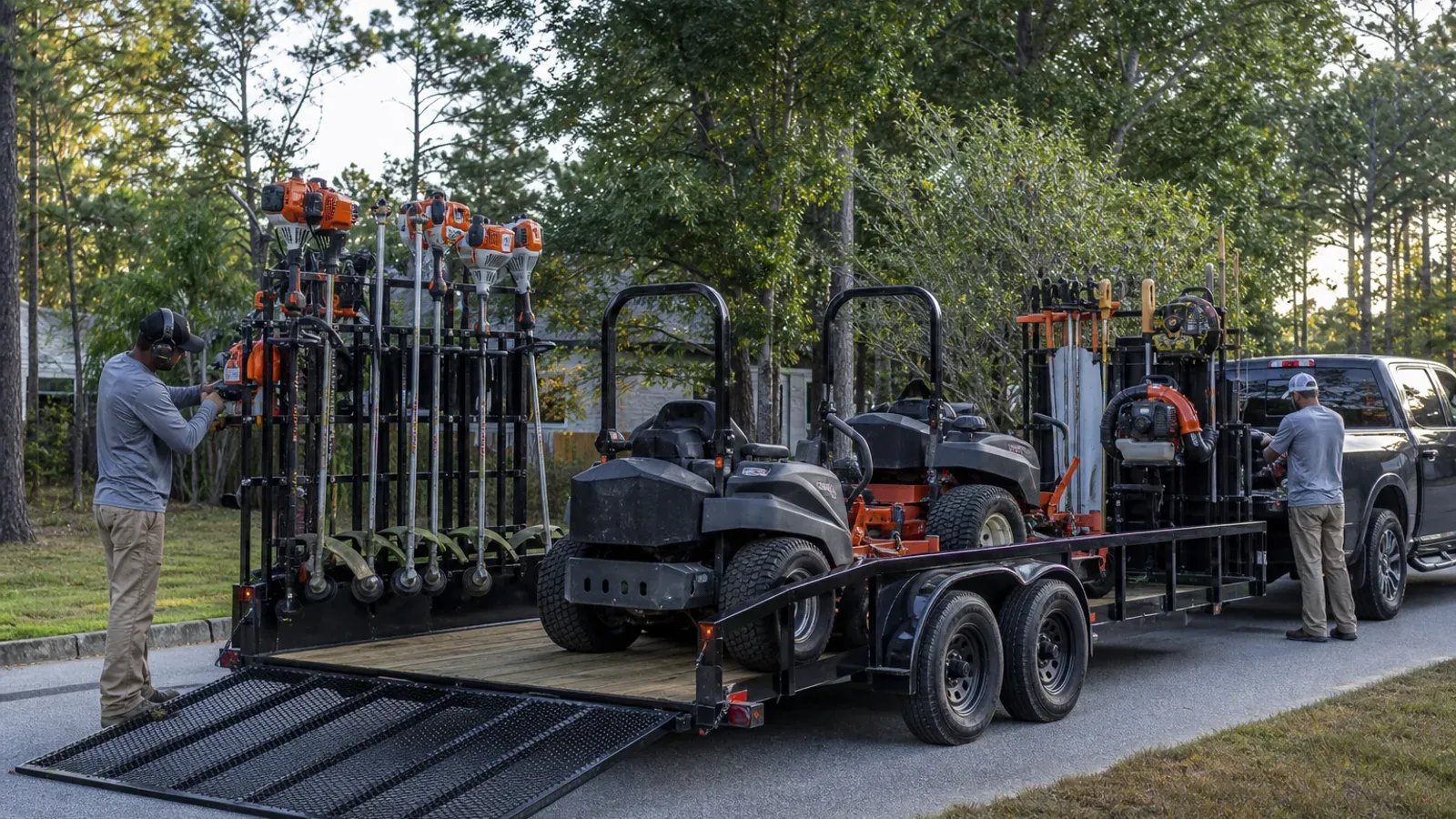
The rack package turns a landscape trailer into the crew's rolling shop. Trimmer racks hold two or three machines locked and isolated, and blower mounts, tool trees, and cooler holders all get placed for route speed. Lockable racks aren't optional, because an open trailer at a gas stop is one of the most predictable losses in the business. Factory racks beat dealer markups, and layout beats everything, since curb-side racks load faster all season long.
The rolling shop's organization layer
Rack-equipped is the third layer of the landscape trailer, after the gate and the walls. It's the mounting system that gives every handheld machine and hand tool a fixed, secured spot you can grab in one motion. Trimmer racks hold two or three units by the shaft, blower racks cradle backpacks, and tool trees on the front rail carry shovels and rakes. Add the spool holders, cooler mounts, and the odd hooks a season collects, and you've got the difference between a crew that grabs and goes and one that digs for everything.
The economics come down to minutes and theft, and both add up. Seconds saved per tool per stop, multiplied across a route's stops and a full season, is real payroll, the same route-efficiency math the guide runs, applied to the racks. Theft is the older problem. Trimmers and blowers walk off open trailers at fuel stops more reliably than almost anything else you own, and lockable racks turn that gamble into a non-event.
The choice is factory, dealer, or catalog, and the guide's advice gets sharper here. Factory racks bolt to reinforced points at fair prices. Dealer-installed racks carry the markup the guide keeps warning about. Catalog racks plus a drill match dealer work for half the money. Just mount them to the frame and reinforced wall points, never to the mesh, or the vibration will shake a cheap install apart by August.
Placement, isolation, and the lock discipline
Layout is what you're really buying. Curb-side racks load faster than street-side on every stop of every day. Put the machines the left-side worker grabs on the driver's-side rack, rack the trimmers shaft-forward so grabbing one is a single motion, set the blowers at a height a loaded back can reach, and keep the tool tree at the front rail where long handles clear the gate's swing. Good builds diagram all this, good crews tweak it, and any rack that fights the route gets unbolted by June.
Isolation is what determines how long the machines last. A trimmer rack that clamps the shafts rigidly sends every road mile straight into the carburetors and clutches. Better designs cradle the shaft in rubber so the trailer's vibration stays with the trailer, and you'll see the difference in the small-engine shop's invoices by year two. The side-rail guide gives the same mesh-mounting warning, and it's the same physics.
Locks finish the system. Integrated locks beat improvised padlocks, and a one-key system beats the foreman's ring of mismatched brass. The part no hardware can sell you is the habit of locking up at every stop, not just at lunch. Hand tools usually ride the tree unlocked, and they walk off accordingly, so the crews that cable-lock the tree stopped donating shovels.
The maintenance note is short. Check the rack fasteners monthly, since vibration loosens everything, replace the isolation rubber once it hardens, and look into any rack that rattles before it throws a machine.
Rack packages by crew
| Package | Typical Contents | The Crew It Serves |
|---|---|---|
| Solo starter | 2-trimmer rack, blower mount, tree | One operator, one route |
| Standard crew | 3-trimmer rack, 2 blower mounts, tree, cooler | The two-to-three-person standard |
| Full route | Dual racks both rails, spool, water, hooks | Big crews, dense routes |
The packages ride the guide's chassis table without changing it, with rack weight taking a modest bite out of payload and placement staying on the walls' reinforced points. Within a package, the specs that matter are lock integration, isolation design, and mounting hardware, and they matter more than the count. Three trimmers on a rigid, unlocked rack are worse than two on a cradled, locked one by every measure that counts over a season.
The rack package's ledger
The buying rule is straightforward. Order factory racks in the build, lay them out curb-biased for your route, get integrated locks and cradled isolation, and use the dealer's install quote for a laugh.
Rack package FAQ
What racks does a crew actually need?
A locking trimmer rack sized to the fleet, a blower mount for each backpack, and a tool tree. That's the standard package. The density options, spools, water, and dual rails, follow the route.
Are lockable racks worth it?
The gas-stop loss numbers answer that before the price does. Get integrated locks on one key and use them at every stop. The hardware just makes the discipline possible.
Why do trimmer racks need isolation?
Rigid clamps send every road mile into the machines, and the small engines pay for it by year two. Rubber-cradled designs keep the trailer's vibration on the trailer.
Factory, dealer, or catalog racks?
Factory in the build is fair money, and catalog racks plus a drill match a dealer install for half. Decline the dealer markup.
Where do racks mount?
On the frame and reinforced wall points only, never the mesh, because of the vibration. Place them curb-side and they load faster on every stop of the season.
Can I add racks to a plain trailer later?
Easily. Catalog hardware on reinforced points is the standard way to grow from hobby to business. You can't really retrofit the gate, but the racks are no problem.