Utility Trailer vs. Landscape Trailer. Which One to Buy.

A landscape trailer is a utility trailer in its work clothes. Same bones, plus a reinforced mower-rated gate, taller sides, and equipment racks. The package costs real money and only earns it back under daily commercial use. Crews running routes buy landscape. Homeowners and occasional haulers buy utility and keep the difference. Of everything on the spec sheet, the gate rating is the line that matters most.
Utility vs. landscape at a glance
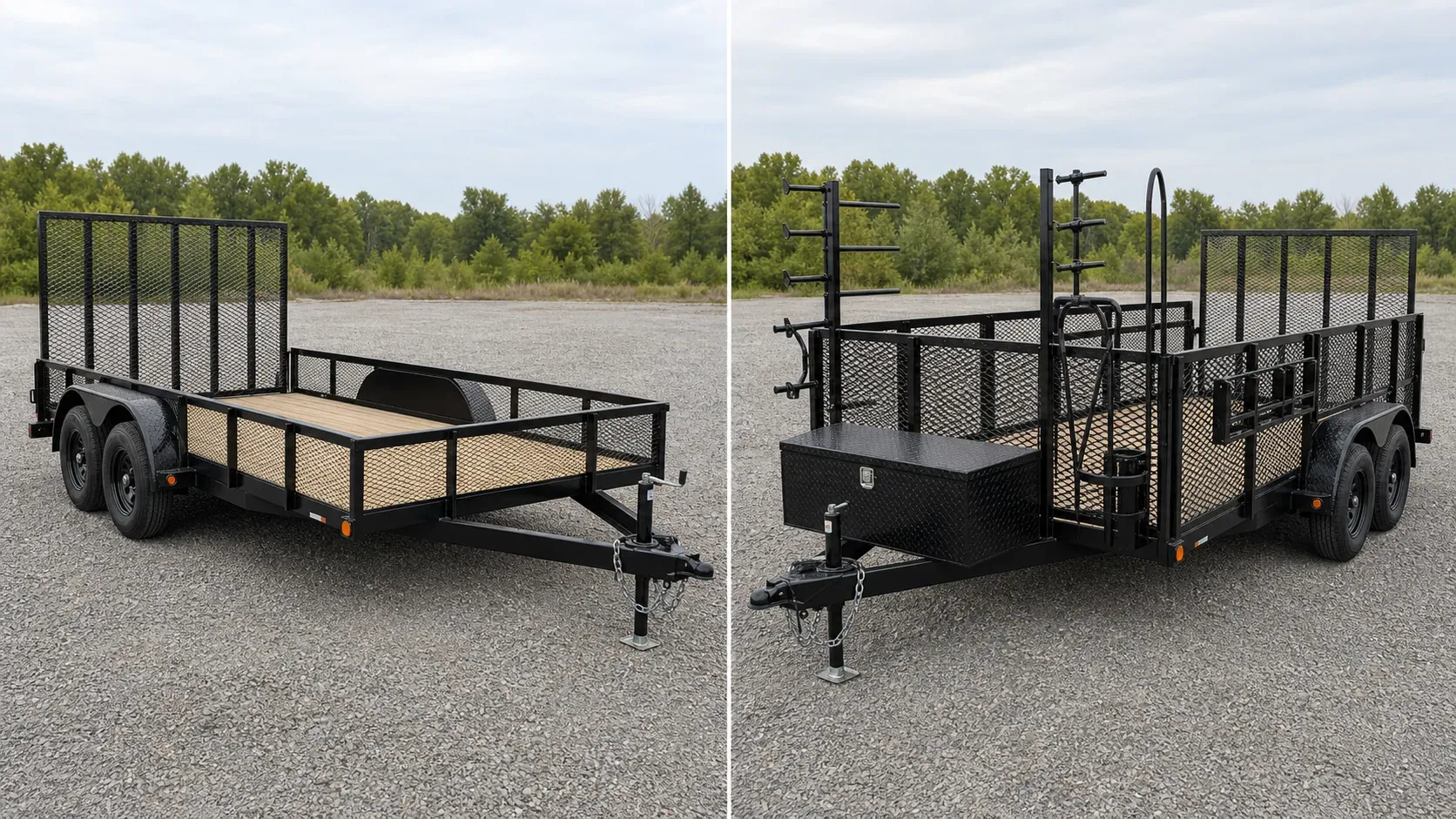
| Utility Trailer | Landscape Trailer | |
|---|---|---|
| The bones | Open deck, rails, gate | The same, upgraded |
| Rear gate | Standard mesh ramp | Reinforced, mower-rated, assisted |
| Sides | 12 to 15-inch rails | 2 to 4-foot options |
| Racks | None | Trimmers, blowers, tools |
| Price | The baseline | A real package premium |
| Duty rating | Occasional to regular | Twenty cycles a day |
| Buyer | Everyone | The green industry |
The utility trailer and landscape trailer share a frame, axles, and silhouette, which is why lots park them side by side and shoppers squint at the price gap. The gap is the trade package, and this whole comparison comes down to one question: does your use justify it?
Pay for the trailer, not the outfit
The utility's argument is that most buyers never stress the parts the landscape package upgrades. A homeowner's mower crosses the gate twice a weekend, not twenty times a day, and a standard gate survives that for a decade. The rails hold the occasional mulch run with a tarp's help. The tools ride in the truck bed like they always have. For that duty cycle, the package premium buys steel that never earns its keep.
Versatility runs the same direction. The bare utility hauls the side-by-side, the household move, the appliance, and the lumber run with no racks in the way, while permanent trimmer racks on a multipurpose trailer are just obstacles with padlocks. The utility guide's whole pitch is breadth, and the unoptioned trailer is the breadth champion.
The money math seals it for the occasional user. The package premium, gate, sides, and racks, runs a meaningful slice of the trailer's whole price, and a homeowner who banks it buys years of fuel and bearings. And if a future season turns the hobby into a business, catalog racks bolt on later for less than dealer package pricing anyway.
The package pays by the cycle
The landscape trailer's argument is arithmetic on cycles. A crew's gate drops at every property, twenty-plus times a day, five days a week, with a 1,200-pound zero-turn rolling over it each way. Standard gates flex, sag, and fail under that math inside a season or two, and a failed gate is a parked route. The reinforced, spring-assisted, mower-rated gate is the single most valuable part on the trailer, and it headlines the package for a reason. The landscape guide runs the full build.
The rest of the package earns its keep on route efficiency. Racks put trimmers and blowers where a crew grabs them in seconds and locks them at the gas station, and taller sides turn the material leg of the day into real yards of mulch. Minutes per stop times stops per day times the season is the ROI formula, and it clears the premium fast for any working crew.
Durability rounds it out. Trade builds spec heavier gate hinges, reinforced fenders crews stand on, and floors rated for daily machine traffic. Those are the parts that separate a trailer that survives commercial use from one that visits the welder quarterly.
Which one you actually need
Buy landscape if the trailer works a route. That's lawn and landscape crews, solo operators building toward a schedule, and any operation where the gate cycles daily and the tools ride exposed. The package premium amortizes across every stop, and the gate rating alone prevents the failure that parks revenue.
Buy utility if the trailer serves a life. Property upkeep, toys, moves, materials, and the mixed catalog of ownership, all at occasional frequency. Keep the premium, tarp the mulch, and let the mower cross a standard gate it will never wear out.
The middle cases sort by the gate. A heavy machine crossing weekly, or any machine crossing daily, points landscape, and everything lighter and rarer points utility. The upgrade path favors starting plain, since racks and side kits bolt onto a utility later, while nobody has ever un-bought a package premium.
Utility vs. landscape FAQ
What's actually different on a landscape trailer?
A reinforced mower-rated ramp gate with assist, taller side options, equipment racks, and trade-grade details like heavier fenders and floors, all on the same utility frame and running gear.
How much more does the landscape package cost?
A meaningful premium over the bare utility, varying by builder and how deep the package runs. Factory packages beat dealer-added racks on both price and mounting.
Can I add racks to a utility trailer later?
Yes, catalog racks bolt on for less than most dealer markups, and it's the standard path for hobbies turning commercial. The gate rating is the one thing you can't practically retrofit.
Is the landscape gate really necessary?
At commercial cycle counts, yes, standard gates fail under daily mower traffic inside a season or two. At homeowner counts, the standard gate lasts a decade. Cycles decide.
Do both tow the same?
Same class, same truck math, same tongue weight rules. Tall landscape sides add some wind manners, which the high-side page covers.
Which holds value better?
Landscape trailers resell strongly to the trade, utilities to everyone. A worked-but-maintained landscape build finds a crew buyer fast, and condition rules either way.