Best Trailers for Fencing Crews.

Fencing hauls long, heavy, and mixed, posts by the bundle, wire by the roll, panels by the stack, and concrete by the pallet, and the flatbed is the trade's standard for exactly that spread. A 16-to-20-foot tandem at 7K to 10K runs residential crews, while the heavy-duty tier and gooseneck flatbeds run ranch miles. The material weights add up faster than the deck fills, so weigh the load list before you buy the deck.
What fence jobs actually weigh
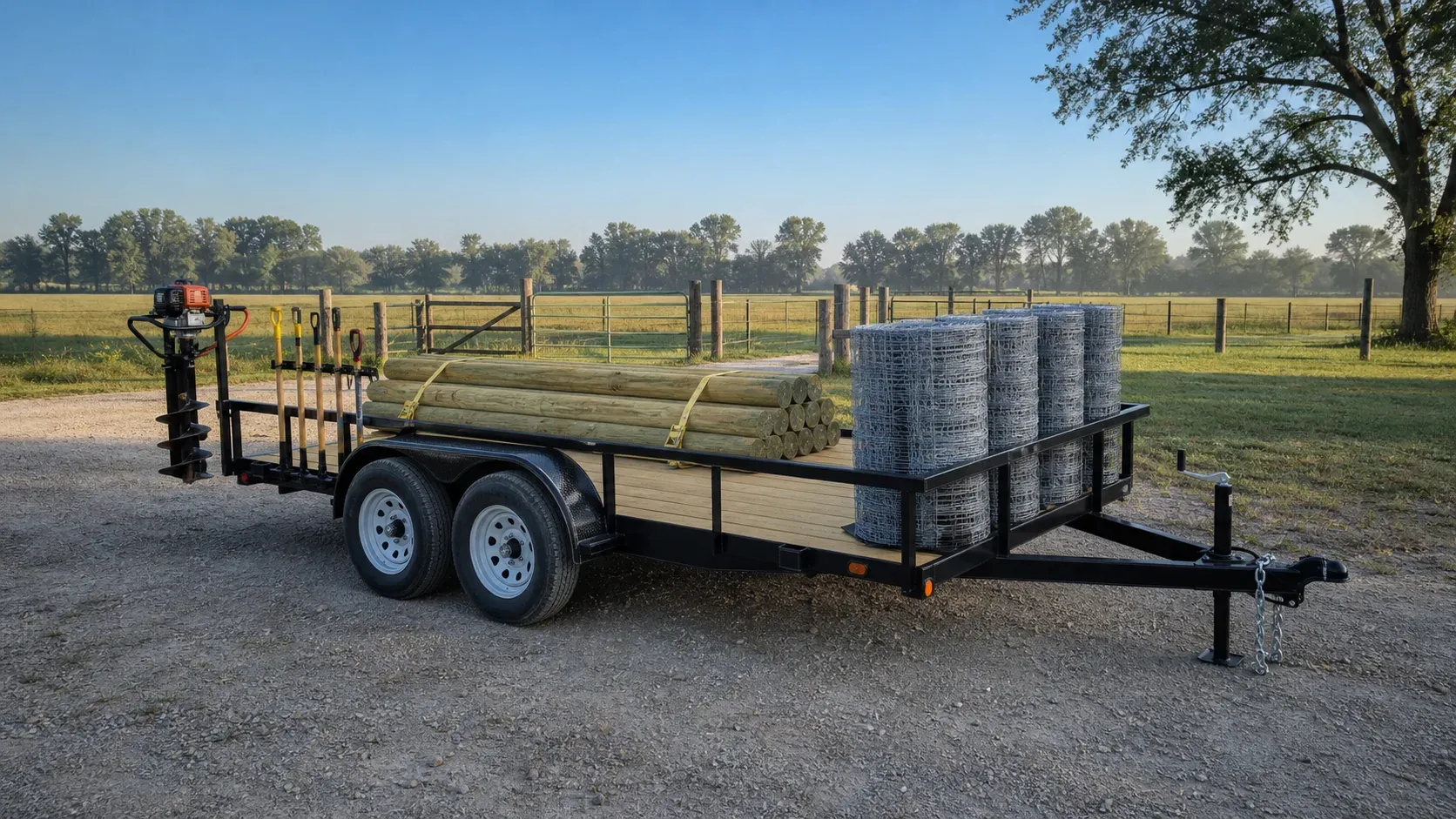
Fence material is the lumber page's density lesson stretched longer, and the table below runs the trade's staples.
| Material | Unit Weight | The Real Load |
|---|---|---|
| Wood posts, 4x4 and 6x6 | 15 to 45 lb each | Bundle of 50, 750 to 2,250 lb |
| T-posts, steel | 8 to 10 lb each | Bundle of 100, 850 to 1,000 lb |
| Pipe posts, 2-3/8 in | 4 to 6 lb per ft | 200 sticks of 8 ft, 6,500-plus lb |
| Wire, barbed and field | 35 to 100 lb per roll | 20 rolls, 700 to 2,000 lb |
| Panels, wire and pipe | 30 to 120 lb each | Stack of 30, 900 to 3,600 lb |
| Concrete, 60-lb bags | 60 lb | Pallet of 56, 3,360 lb |
The lesson is the familiar one. A full job's package, posts, wire, panels, and concrete, crowds the 7K class on one modest residential job and buries it at ranch scale. Pipe-fence work is really just steel hauling, so let the payload math do the honest accounting per load. Length matters too, since 16-to-20-foot pipe sticks and rail stock run into the overhang rules every state sets.
Best trailers for fencing, ranked
The standard is the tandem flatbed, 16 to 20 feet at 7K-to-10K for residential and farm crews. The open deck takes posts by forklift and wire by hand, the stake pockets hold the uprights that pen the bundles, and the rub rail takes the strap pattern long stock demands. The heavy-duty tier serves the commercial crew's daily packages, and pipe outfits add welded pipe racks over the deck. That rack is the trade's signature modification, carrying sticks high and leaving the deck free for pallets.
The ranch tier steps up to the gooseneck flatbed, which hauls miles of fence in fewer trips. It's the farm and ranch page's standard trailer putting in its fencing week, with the one-ton already in the yard under it. The support trailers follow the operation. On commercial crews an enclosed shop carries the tool inventory, an equipment deck hauls the skid steer with the auger that digs the line, and a utility trailer runs the punch-list days.
Long loads, staged drops, and the line's rhythm
Load for the line, not the yard. Fence jobs unload in sequence down the run, so stack the deck in reverse, first-planted posts on top, wire and clips within reach, and concrete pallets over the axles for tongue weight. Strap the whole stack the way the materials pattern lays out, over-the-top straps at intervals, uprights in the pockets to pen the bundles, and edge protection where straps meet pipe.
The long-stock rules ride on every pipe and rail load. Flag and light the rear overhang past your state's threshold, mind the front overhang at the cab, and watch for the tongue-weight creep that rearward sticks cause, checked at the deck mark. Off-pavement miles add the ranch notes. Walk the tires after rocky two-track, keep speeds moderate on washboard, and rinse the fence line's mud off the brakes it packs into them.
Then there's the rhythm of the work. The trailer stages down the line as the crew moves, and whoever's nearest a truck moves it. That's the quiet argument for the bumper-pull's any-truck flexibility on multi-truck crews, and for the maintenance calendar that keeps the fleet's one deck earning through a season it can't afford to sit out.
Fencing trailer FAQ
What trailer do fencing crews use?
The 16-to-20-foot tandem flatbed at 7K-to-10K is the residential standard, with heavy-duty and gooseneck flatbeds at ranch and commercial scale, and pipe racks over the deck for pipe outfits.
How much does fence material weigh?
Quick math: wood posts 15 to 45 pounds each, pipe at 4 to 6 per foot, concrete 3,360 a pallet. One job's package crowds a 7K deck, as the table above shows.
How do I haul 20-foot pipe legally?
Deck length plus legal rear overhang, flagged and lit past the state threshold. Check the rules for the limits. Pipe racks carry the sticks high and legal.
What truck runs a fencing operation?
Half-tons under residential decks, three-quarter-tons under the 10K-plus packages, and the ranch's one-ton under the gooseneck.
Flatbed or utility trailer for fencing?
The flatbed's open deck and length own the material leg, and the utility handles punch-list days. Crews that fence weekly own the flatbed by the second job.
How should fence material be strapped?
Use the lumber pattern: over-the-top straps at intervals, stake-pocket uprights to pen the bundles, edge protection on pipe, and a re-tension at ten miles, every load.