Trailer Hitches Explained. Every Type Compared.

Four hitch families cover towing. The receiver hitch and ball handles everything through roughly 16,000 pounds, the gooseneck moves heavy loads into the truck bed, the fifth wheel does the same for RVs, and the pintle's ring-and-hook owns severe duty and commercial weights. Your trailer's coupler already chose the family for you. This page maps them, and the family pages carry the details.
Four ways to join truck and trailer
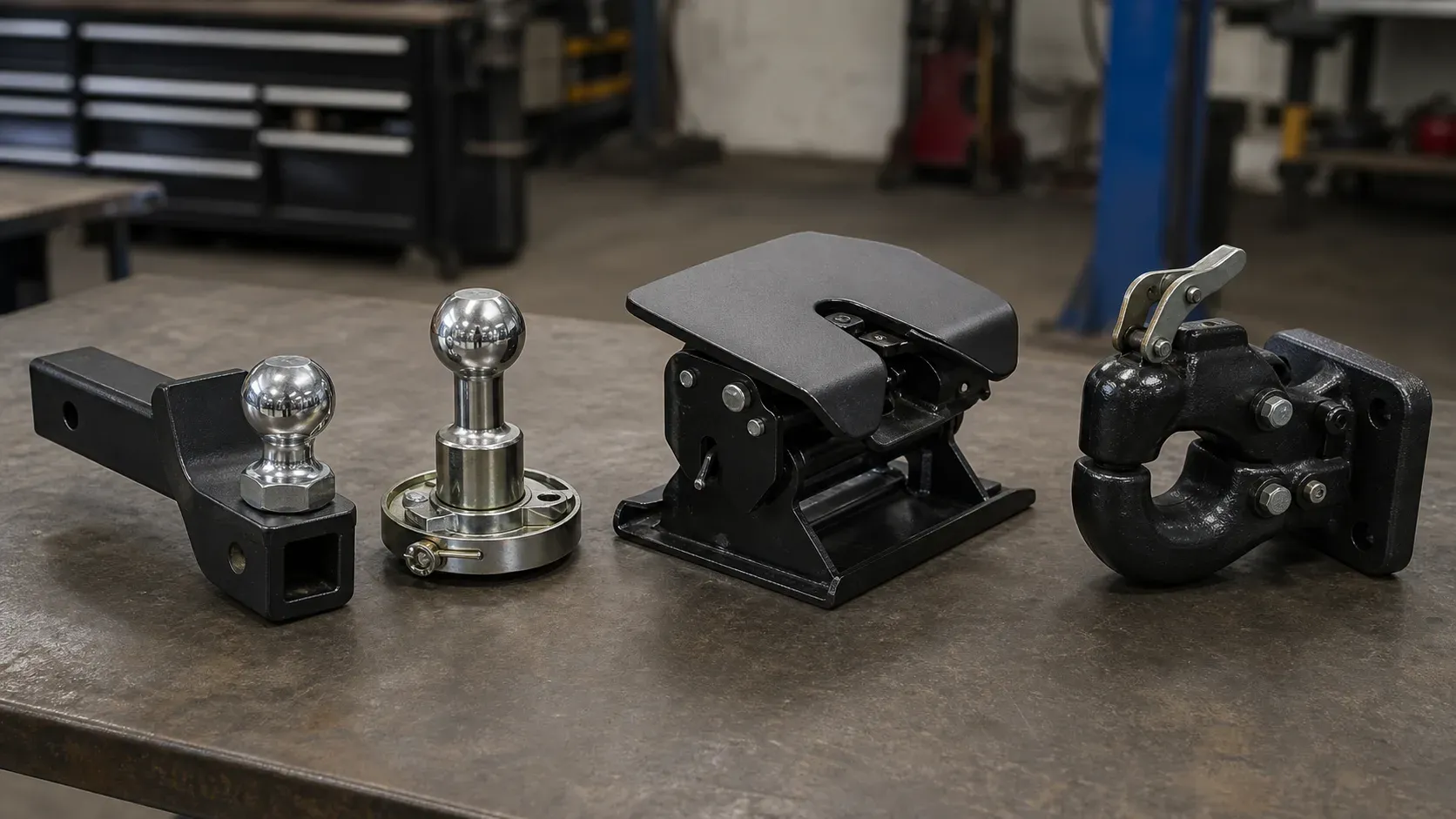
Every hitch answers the same two questions, where the trailer's weight lands on the truck and how the joint articulates, and the four families are four answers. The receiver and ball carries tongue weight behind the rear bumper, and it's universal, cheap, and honest through the 14-to-16K classes. The gooseneck ball moves the load into the bed over the rear axle, the work world's heavy answer. The fifth wheel does the same job the RV way, with a plate and kingpin and cushioning, per the comparison. And the pintle's ring-and-hook trades smoothness for ratings and abuse tolerance at commercial scale.
The choice is rarely yours to make. Trailers arrive with couplers already fitted, bumper-pull trailers with ball couplers sized 2 inches or 2-5/16, goosenecks with neck couplers, RVs with kingpins, and military and commercial tags with lunette rings. Matching the truck to the trailer's existing answer is the actual task. The one genuine decision point is the purchase fork the gooseneck-versus-bumper-pull page referees, made once, at the trailer, around 14,000 loaded pounds.
How hitch ratings stack
The hitch is a chain of rated parts, and the lowest number governs, which is the site's oldest rule applied at the joint. The receiver class, ball mount, ball, and coupler each carry their own rating, and the system is only as strong as its weakest link. A Class V receiver above a 6,000-pound ball is a 6,000-pound hitch.
| Family | Typical System Ratings | The Governing Parts |
|---|---|---|
| Receiver and ball | 3,500 to 20,000 lb by class | Receiver class, ball, mount |
| Gooseneck | 25,000 to 30,000 lb | Ball, bed rails, truck payload |
| Fifth wheel | 16,000 to 27,000 lb | Hitch rating, truck payload |
| Pintle | 10,000 to 60,000+ lb | Hook, ring, mounting |
Two ratings travel with every family. Receivers carry weight-carrying versus weight-distributing figures, the same hardware rating higher once a distribution hitch spreads the tongue. And the truck's payload sits over all of it, since no hitch rating beats it. The bed-mounted families in particular are payload purchases wearing hitch costumes.
Matching the joint to the job
The trailer decides, the weight confirms, the equipment finishes. Bumper-pull trailers through the 14K classes run the receiver family, with the ball sized to the coupler and the class sized to the load. Heavy work trailers run the gooseneck, the fork crossed once per the comparison. RVs run fifth wheels. Severe-duty and commercial tags run the pintle, and combination hitches serve the mixed fleets that visit both families.
The equipment layer completes every family. You need the brake controller from 3,000 trailer pounds, wiring matched to the trailer's plug, mirrors that cover the width, and the distribution hitch at the receiver family's honest top. Each has its own page, and each is cheaper than what it prevents.
Hitch FAQ
What hitch do I need for my trailer?
The one that matches its coupler, ball couplers to receivers, neck couplers to gooseneck balls, kingpins to fifth wheels, lunette rings to pintle hooks. The trailer already chose.
What do receiver hitch classes mean?
Rated tiers, Class I through V, roughly 2,000 through 20,000 pounds, detailed on the receiver page. The class caps the system alongside every other part's rating.
Why do heavy trailers use bed-mounted hitches?
Geometry. The weight sits over the rear axle instead of levering behind the bumper, the physics the comparison runs. Past 16K there's no receiver conversation.
Can one truck have multiple hitch types?
Routinely. A receiver plus gooseneck pucks is the working standard, and combination pintle hitches add the ring. Fleets standardize exactly this way.
Does a bigger hitch increase what I can tow?
Never past the lowest number in the chain, truck ratings and payload included. The hitch matches capacity, it doesn't create it.
What's the most common hitch mistake?
The mismatched ball, a 2-inch coupler dropped on a 2-5/16 ball or the reverse, secure-looking and lethal. Match the stamps at every hookup.