Electric vs. Electric-over-Hydraulic Trailer Brakes.

Electric drum brakes run most of the trailer world through the 14K classes. They're cheap, simple, and controlled straight from the truck's brake controller. Electric-over-hydraulic puts a pump on the trailer and hydraulic force at the wheels, which buys stronger, smoother stops and self-adjustment where discs are used, at a real price. Through the working classes, electric does the job. At the heavy gooseneck tiers and on surge-prone loads, EOH earns its premium on every stop.
Electric vs. EOH at a glance
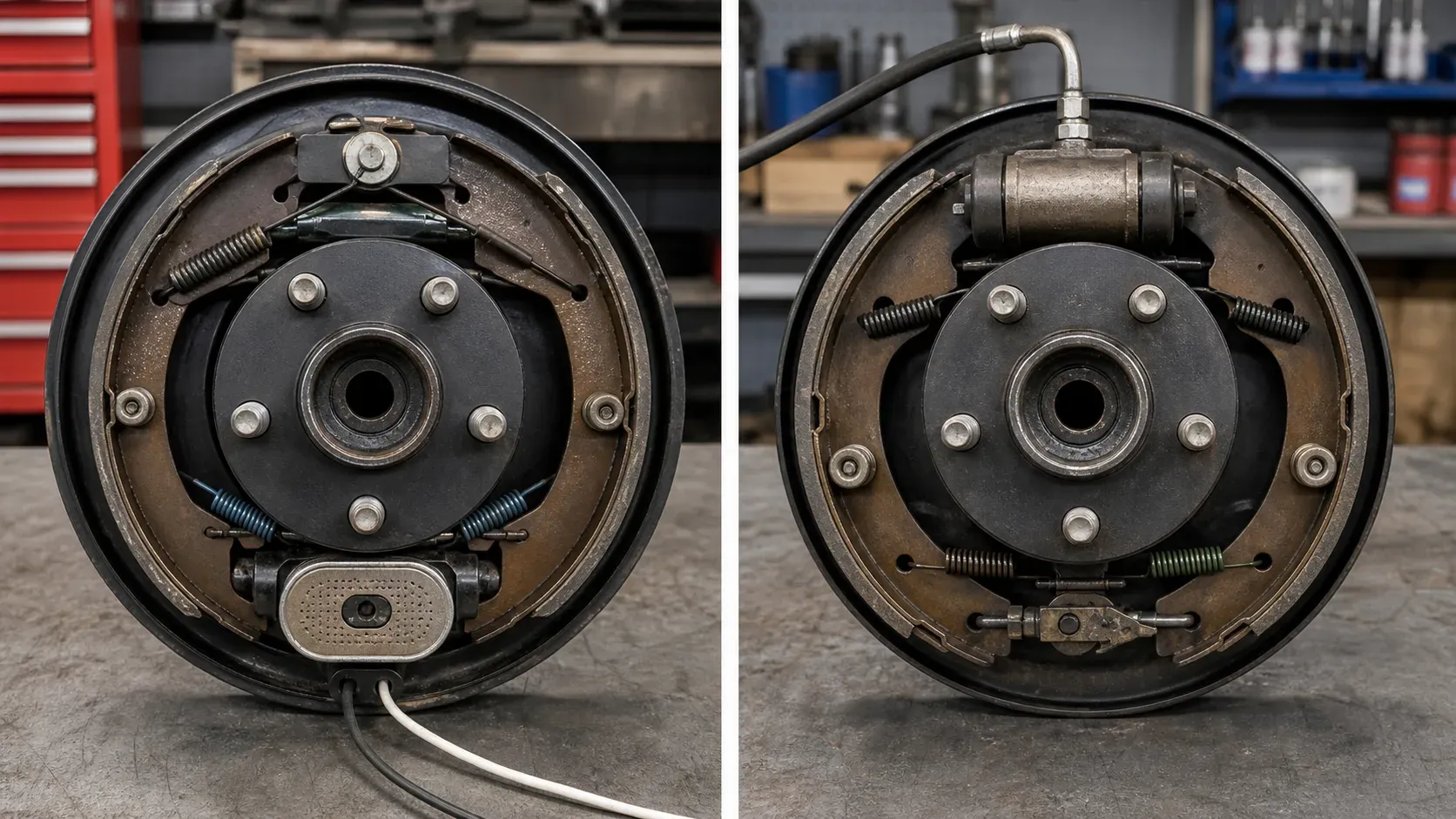
| Electric Drum | Electric-over-Hydraulic | |
|---|---|---|
| Stopping force | Honest through 14K | Stronger, disc options |
| Cost | The baseline | The premium, pump included |
| Control feel | Good, controller-tuned | Smoother, more linear |
| Maintenance | Adjusters, magnets, shoes | Fluid, pads, sealed lines |
| Weight classes | Through 14-to-16K | The heavy tiers' choice |
| Truck side | Standard controller | Same controller, EOH-capable |
Both systems hang off the same truck-side hardware. One brake controller commands either, and the fundamentals they share are covered on the brake page.
The standard that earned it
Electric drums win on fitness for the job at the price of an option checkbox. Magnets press shoes inside the drum in proportion to the controller's signal, the whole system costs little, and parts are on every shelf. Through the 7K, 10K, and 14K classes, it stops the trailer honestly when it's adjusted and powered right. The working world runs on electric because electric works.
The downsides show up with weight and neglect. Drums fade on long descents, self-adjustment is imperfect and manual checks are real, and at the heavy gooseneck tiers the magnets simply run out of force against the mass.
Hydraulic force, electric brains
EOH wins on force and feel. The controller's signal drives a pump on the trailer, the pump pushes fluid to hydraulic calipers or wheel cylinders, and you get car-like braking at trailer scale, stronger, smoother, and self-adjusting on the disc versions. The 20K-and-up world specs it as the working answer, and the heavy classes treat it as the floor below air.
The downsides are dollars and complexity. The pump, lines, and discs cost real money, fluid joins the maintenance calendar, and the battery-and-wiring chain that feeds the pump needs the same inspection discipline described on the wiring page.
The class decides
Read the GVWR first. Through 14K, electric drums serve honestly, tuned by the controller and checked on schedule. At 16K the conversation opens, with grades and duty cycles casting votes. From the 20K gooseneck middle up, EOH is the working spec, and air systems take over past 30K, as the heavy pintle world lays out. Buyers stuck between classes should weigh the routes, because mountain miles and heavy cycles buy hydraulic force early.
Electric vs. EOH FAQ
Do both work with my truck's brake controller?
Modern controllers handle both, with an EOH setting for the pump. Just verify the controller's EOH compatibility before you buy the trailer. The controller page has the details.
When is electric not enough?
At the heavy gooseneck tiers, on long grades, and under surge-heavy loads, roughly the 16-to-20K line depending on duty. Above that, EOH is the spec, not the upgrade.
What maintenance does each need?
Electric wants adjustment checks, magnet and shoe wear, and clean connections. EOH wants fluid condition, pad wear, and a healthy pump circuit. Both want the breakaway system tested.
Is EOH worth it on a 14K trailer?
On mountain routes and daily commercial cycles, arguably yes. On general work, electric serves the class honestly and the premium buys margin elsewhere.
What about air brakes?
That's the commercial tier past 30K, glad hands and CDL territory, covered on the heavy classes page. EOH is the heaviest system before that world.