Pintle vs. Ball Hitch. Which Connection to Buy.

The ball coupler tows smoother and quieter, and it handles nearly all personal and pavement hauling. The pintle's ring-and-hook rates far higher and shrugs off terrain and abuse that would destroy a ball coupler, but it announces every start and stop with its trademark clunk. Severe duty, off-road sites, and mixed fleets buy pintle. Everything else keeps the ball, and for good reason.
Pintle vs. ball at a glance
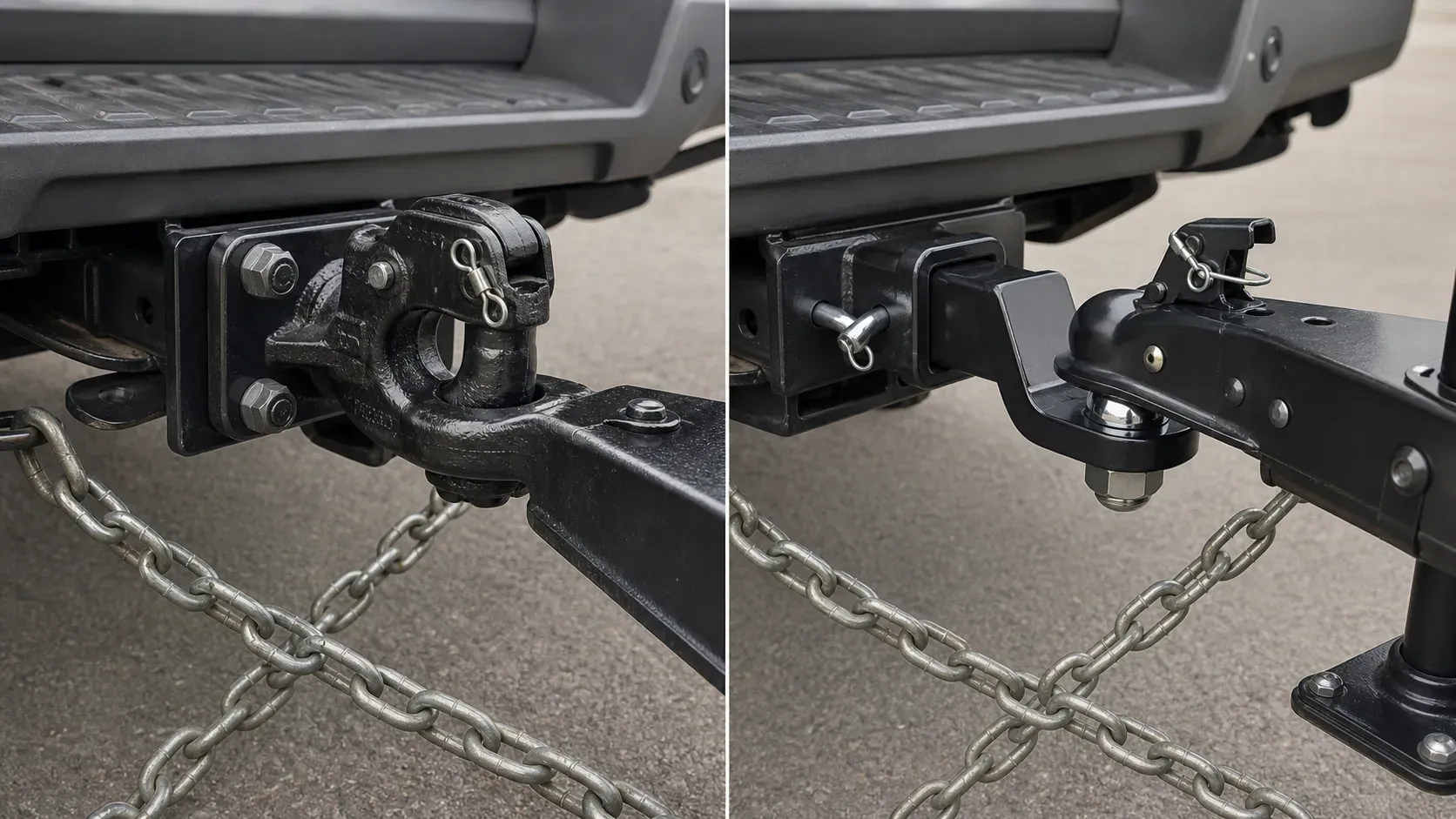
| Ball Coupler | Pintle Ring-and-Hook | |
|---|---|---|
| Ratings ceiling | ~30,000 lb, gooseneck balls | 60,000+ lb heavy classes |
| Pavement manners | Smooth, quiet | The clunk, every transition |
| Rough terrain | Precise fit suffers | Built for it, slop as tolerance |
| Wear model | Fit loosens, ball wears | Forged parts, minimal fit to lose |
| Fleet flexibility | Sizes must match | Combination hitches serve both |
| Availability | Everywhere | Fleet and commercial channels |
| Cost | The baseline | Comparable hardware, rated higher |
This is the connection question sitting under the pintle world on one side and the ball world every other trailer on this site rides on the other. Both hardware families are honest inside their duty cycles. The only real mistake is a mismatch in either direction.
Smooth serves the majority
The ball wins on fit. The coupler grips a machined sphere in near-total contact, so it transmits the road smoothly, tows silently, and articulates through every normal maneuver without complaint. That's why the ball owns personal towing, pavement freight, and everything the utility, cargo, and car hauler worlds hitch to. The gooseneck ball stretches the family past 25,000 pounds, covering the heavy classes right up to commercial tags.
Infrastructure only adds to it. Balls and couplers sit in every parts store, the sizes are standardized, and a receiver hitch already hangs under every truck sold. That universality is a quiet spec no pintle plate can match.
The downside is the same precision that makes it work. That machined fit suffers from dirt, impact, and hard angles, and off-road shock loads peen and loosen what pavement never stresses. A worn coupler develops the same slop a pintle has from the factory, just without the design behind it. And the ratings ceiling, generous as it is for personal towing, ends where commercial tags begin.
Tolerance serves the severe
The pintle is the whole thesis of the pintle guide: forged simplicity, rated past everything, with the slop as the feature. The ring rides loose in the hook and absorbs the angles, shocks, and misalignment rough ground throws at it. There's no machined fit to peen and no precision to lose, and ratings run to 60,000-plus pounds because a solid forged ring has nothing to limit it. Construction sites, municipal fleets, agriculture, and the military tradition that started it all run pintle for exactly this durability, which the tag and equipment pages cover in detail.
The fleet case seals it. A combination hitch, a hook with a ball in its jaw, lets one truck serve both connection families. That's the standardization dividend, any truck moving any trailer in the yard.
The downside is the noise and the manners. The same slop that tolerates terrain announces every start, stop, and pothole on pavement, the clunk every operator knows. At equal ratings, the ball simply tows nicer where roads are smooth, which is why the pintle never took over the personal market it out-rates.
Duty cycle decides the hardware
Terrain decides most cases. Trailers that live on pavement behind personal trucks keep the ball at any rating the ball family covers, because a smooth tow beats tolerance nobody uses. Trailers that live in the dirt, on job sites, in fields, and on the rough ground between, buy the pintle's indifference, which matches the buyer profile in the pintle guide.
Fleet needs decide the rest. Mixed yards standardize on pintle or combination hitches for the any-truck-any-trailer payoff, while single-trailer owners never see it. Weight ends the debate above 30,000 pounds, where the heavy tier settled on the ring decades ago and the ball family simply doesn't exist.
One honest crossover note. Receiver-mount pintle plates bring the ring to any pickup, but they're rated at the receiver, not the ring, and the lowest-number rule applies as always. If you're adding pintle capability to a personal truck, price the truck-side hardware carefully. It has to be frame-mounted and rated, never bolted to the bumper's sheet metal.
Pintle vs. ball FAQ
Why do pintle hitches rattle?
The ring rides loose in the hook by design, and that slop absorbs shock and angle off-road. On pavement it turns into the clunk you hear at every transition. Reduced-slop hooks quiet it down somewhat.
Which connection is stronger?
The pintle, by ceiling. Heavy classes rate past 60,000 pounds, while the biggest gooseneck balls stop near 30,000. Inside the ball's range, both exceed what any pickup can legally tow.
Can I put a pintle hook on my pickup?
Yes, with receiver-mount plates or bolt-on combination hitches, but they're rated at the receiver and mount, not the ring. Use frame-mounted hardware only, since the whole rating chain depends on it.
What's a combination hitch?
A pintle hook with a ball built into its base, so it tows either family. It's the fleet standard because one truck can serve the whole yard.
Is pintle overkill for personal towing?
On pavement, honestly, yes. The ball tows the same weights and rides nicer doing it. The pintle earns its clunk where terrain and duty are severe, which personal towing rarely is.
When is pintle mandatory?
Above the ball family's ratings, meaning the 30,000-plus commercial tag tier. And effectively anywhere fleet standardization or severe terrain has already made the call.