Dump Trailer vs. Equipment Trailer. Which One to Buy.

An equipment trailer hauls machines, a dump trailer hauls material, and most contractors eventually need both jobs done. The equipment trailer carries the skid steer properly and the dirt not at all. The dump moves the dirt in seconds and carries a machine only through a ramp-gate compromise. If you can buy just one, pick by which cargo earns more, and know that the ramp-gate dump is the only real crossover between them.
Dump vs. equipment at a glance
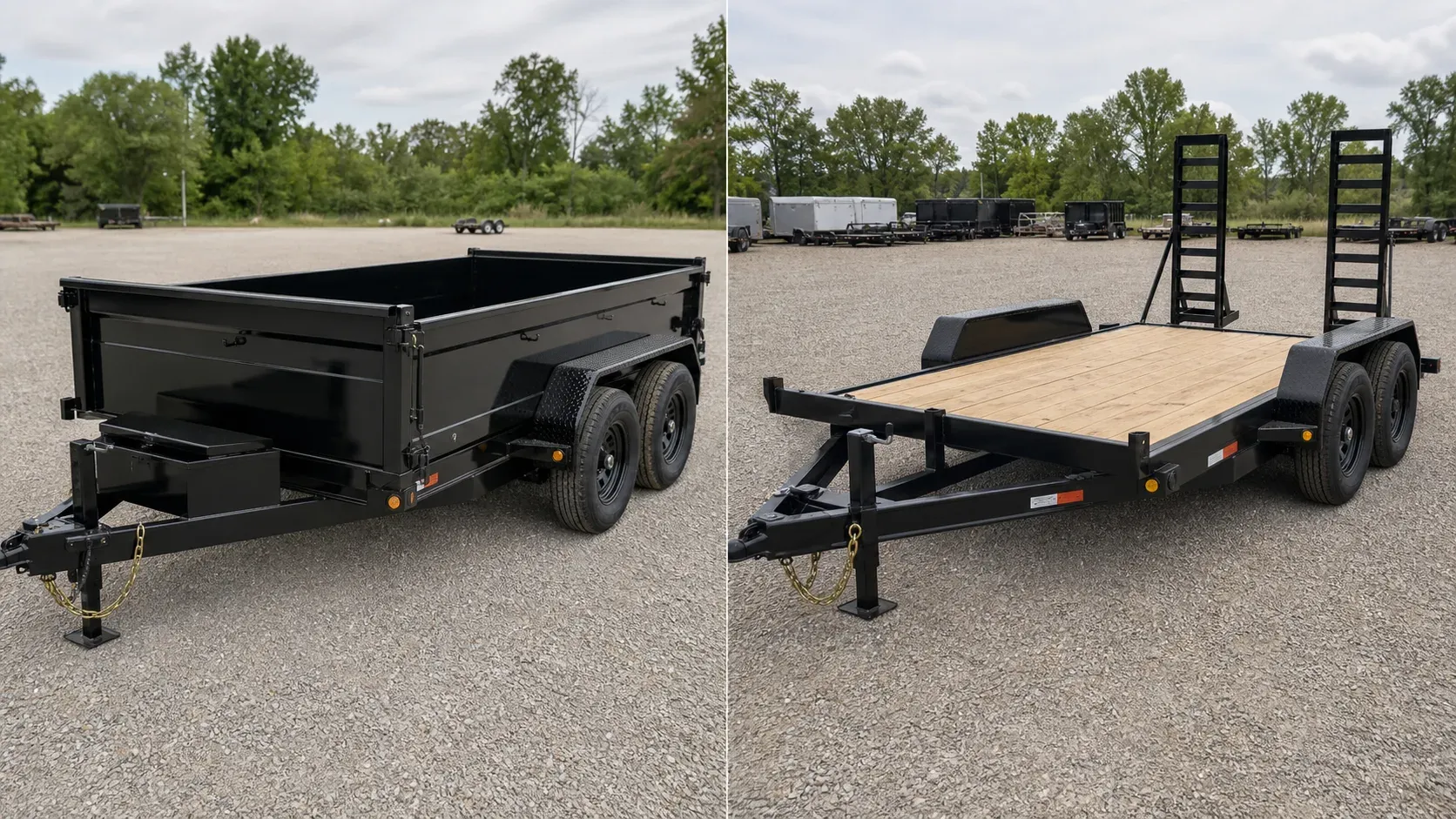
| Dump Trailer | Equipment Trailer | |
|---|---|---|
| Loose material | The whole point | No, open deck |
| Machines | Ramp-gate models, limited | The whole point |
| Unloading | Hydraulic, self-serve | Drive it off |
| Payload per GVWR | Lower, box and hydraulics | Higher, lean deck |
| Deck length | 12 to 16 ft boxes | 16 to 24 ft decks |
| Price, 14K class | Higher, hydraulics | Lower, simpler build |
| Maintenance | Pump, battery, cylinder | Bearings, ramps, brakes |
The dump and equipment trailers share the 14,000-pound class, the same tandem axles, the same three-quarter-ton truck math, and the same contractor customers, which is exactly why the comparison comes up. They are the two tools of the dirt-and-machines trade, and the question is never which is better. It is which job you cannot afford to do badly.
Material is money
The dump owns everything loose, soil, gravel, and demolition debris delivered and dumped in half a minute per load. Grading, excavation cleanup, hardscape supply runs, and storm work all live in the box, and once you are doing that weekly, the labor saved against hand unloading pays the hydraulic premium. The dump guide runs the full case.
The crossover argument belongs to the ramp-gate dump. Swap the barn doors for a rated ramp gate, and the low-profile builds especially will carry a compact machine inside the box, mini skid steers, small excavators, and plate compactors, legitimately and legally, as long as the bed's payload and tie-down points are rated for it. That is a real capability with real limits. Box length caps the machine size around the compact classes, the floor is not an equipment deck unless it was built as one, and the side walls complicate chain angles. One trailer doing 80 percent of both jobs is the pitch, and for light-machine operations it is an honest one.
Against machine work, though, the costs are clear. Deck length runs short, a 14-foot box against an 18 to 20-foot deck. Payload suffers, since the hydraulics and box eat weight that a lean equipment deck keeps for cargo. And loading geometry fights you, walls and a gate instead of an open deck with proper ramps.
Machines ride right
The equipment trailer carries anything that drives aboard, skid steers, mini excavators, tractors, lifts, and attachments, on decks and tie-downs engineered for exactly that. Full-size machines with attachments simply do not fit the dump crossover. An 8,000-pound skid steer wants the 18 to 20-foot deck, the 16-inch crossmembers, and the rated D-rings the equipment guide specs, and no gate option changes that.
Payload efficiency is the quiet advantage. The equipment trailer spends its GVWR on cargo instead of on box walls and hydraulics, so a 14K equipment trailer commonly out-hauls a 14K dump by 1,500-plus pounds of actual payload. For machine weights that crowd the class ceiling, that margin is the difference between legal and lying.
Simplicity pays daily too. No battery to die, no pump to service, no cylinder seals, just bearings, brakes, ramps, and rubber. What it offers against material hauling is nothing. An open deck holds exactly zero yards of gravel, and any contractor who has tarped a pallet of bagged stone onto one knows the workaround has a ceiling.
Which one you actually need
Buy the equipment trailer if machines are the business. The skid steer earns the money, it rides properly or the work stops, and material runs get handled by supplier delivery, a dump site's loader, or a second trailer down the road. For a full-size machine there is no debate. The deck wins.
Buy the dump if material is the business. Grading, hauling, cleanup, and debris volume pay the bills, your machines are compact or occasional, and the ramp-gate low-pro configuration covers the mini equipment honestly. This is the one-trailer answer for light-machine dirt work, and it is the only direction the crossover runs.
Buy both when both cargos earn, which is where most growing dirt-work operations land within a few seasons. A 14K equipment trailer and a 14K dump behind two trucks is the standard small-contractor fleet for a reason. Buying the first one right means buying whichever cargo earns more today, with the second already penciled in.
Dump vs. equipment FAQ
Can a dump trailer haul a skid steer?
Compact machines can ride ramp-gate models with rated floors and tie-downs, within the bed's payload. Full-size skid steers with attachments belong on an equipment trailer's deck, since the box runs out of length and payload first.
Can an equipment trailer haul gravel or dirt?
Not loose, because the deck is open. Bagged and palletized material rides fine. If loose material is regular work, that is the dump's whole job description.
Which carries more payload at 14K?
The equipment trailer, usually by 1,500 pounds or more. Its lean deck spends GVWR on cargo where the dump spends it on box and hydraulics.
Which costs more?
The dump, class for class, and the hydraulic system is the difference. An equipment trailer's premium features, ramps and dovetails, cost less than pumps and cylinders.
Same truck for both?
Yes. The 14K class wants a three-quarter-ton minimum either way, with tongue weight counted against payload honestly.
What's the real one-trailer answer?
The ramp-gate low-profile dump, for operations whose machines are compact and whose material is constant. It does 80 percent of both jobs, and the missing 20 percent is full-size machines.