Bumper-Pull Equipment Trailers Explained.

A bumper-pull equipment trailer hooks to a standard receiver or bumper ball and hauls machines honestly through the 14,000-pound class. It's the default in the equipment world, cheaper than a gooseneck and compatible with any properly rated truck, and hitch physics cap it right around where full-size machines start to crowd it. Loaded under 14K, this is the answer. Past that, read the gooseneck page.
What a bumper-pull equipment trailer is
Bumper-pull describes the connection every trailer owner already knows, a coupler dropped over a ball behind the truck, and on an equipment trailer it sets the working envelope. This setup owns the market from 10,000 through 14,000 pounds GVWR, the classes where compact tractors, skid steers, and mini excavators live. It owns them because it's the simplest, cheapest way to move a machine behind a truck you already have.
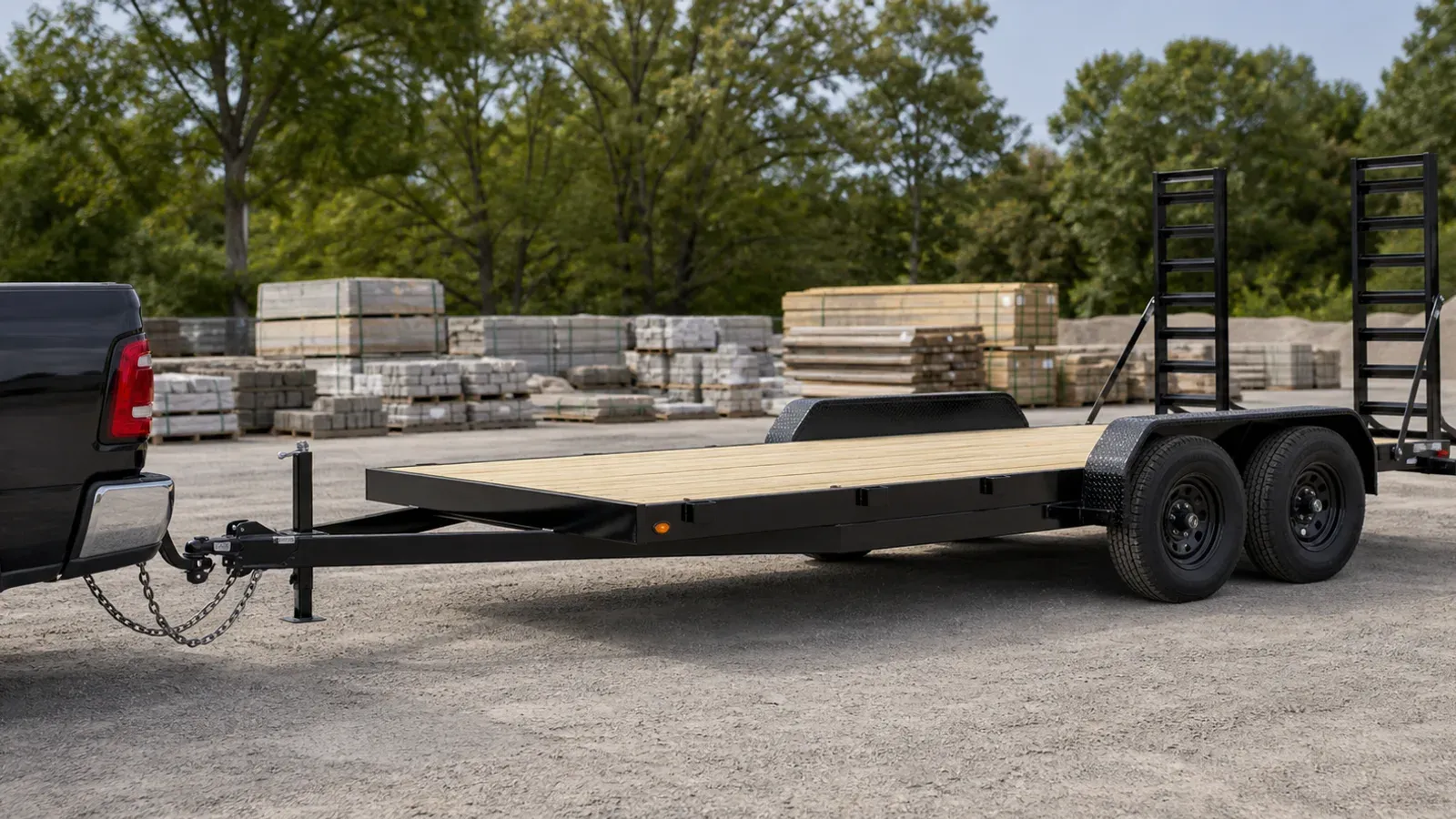
The whole build serves the machine. Deck lengths run 16 to 22 feet over 16-inch crossmembers under treated wood, with rated ramps at the rear, D-rings set for chain angles, and tandem axles braked all around at the 14K tier. Everything the guide specs applies here. This page is about what the hitch adds and takes away.
What it adds is reach. It runs on a 2-5/16 ball on a rated receiver, which nearly every work truck already carries, so there's no bed hitch to install and no bed space to give up, and any properly rated truck in the fleet can grab it. Resale works the same way, since a bumper-pull equipment trailer sells to the widest buyer pool in the heavy market.
What it takes away is ceiling. The hitch weight hangs off the back of the truck as leverage instead of riding over the axle, and somewhere around 14,000 to 15,000 pounds loaded, the physics start favoring the gooseneck. The comparison draws the exact line. Put plainly, if your machine regularly crowds 14K, you're reading the wrong page.
Tongue weight, trucks, and the 14K ceiling
Tongue weight runs the bumper-pull's math. Ten to 15 percent of loaded weight belongs on the ball, which on a loaded 14K trailer is 1,400 to 2,100 pounds pressing down behind the rear axle. That weight counts against the truck's payload rating, the spec that runs out long before tow ratings do. That's why loaded 14K work is three-quarter-ton territory at a minimum. A half-ton's tow rating might cover the trailer, but its payload can't cover the tongue.
Machine placement is your tongue-weight dial. Where the machine sits on the deck sets the balance, forward of the axle to hit the target percentage, and an equipment trailer gives you feet of adjustment that fixed cargo never offers. Load the machine, judge or measure the squat, move the parking spot, chain it down, and mark the deck for next time. Loading a machine too far back is the classic recipe for bumper-pull sway, and at these weights, sway is not academic.
A weight-distribution hitch earns its keep at the top of this class. Its spring bars lever the tongue load back across both truck axles and the trailer's, which flattens the squat and restores steering authority at the front axle, and most 14K bumper-pulls behind three-quarter-tons tow noticeably better with one. It's a few hundred dollars solving a problem the gooseneck solves with its structure, which sums up the whole setup fairly well.
The rest is the guide's standard kit. You want brakes on every axle with a controller tuned to the load, a rated coupler with safety chains crossed under the tongue, a breakaway system you test every year, and a drop-leg jack sized to the real nose weight.
Bumper-pull equipment sizes and payload
| Class | Typical GVWR | Typical Payload | Common Fit |
|---|---|---|---|
| 16 to 18 ft, 10K | 9,900 to 10,400 lb | 7,000 to 7,800 lb | Compact tractors, small skid steers |
| 18 to 20 ft, 14K | 14,000 lb | 9,400 to 10,400 lb | The working standard |
| 20 to 22 ft, 14K | 14,000 lb | 9,200 to 10,200 lb | Longer machines, dual compacts |
| 22 to 24 ft, 15 to 16K | 15,000 to 16,000 lb | 10,300 to 11,700 lb | The ceiling, gooseneck territory begins |
The 14K tier is the center of gravity for this setup, and its payload math is the whole buying decision. You have 9,400 to 10,400 usable pounds to cover your machine plus its heaviest attachment plus fluids plus the margin that keeps you off the edge of the rating. An 8,000-pound skid steer with a 1,200-pound breaker fits with room to spare. A 10,000-pound excavator is already the gooseneck conversation.
The 9,900 badge shows up here for the same reason it does everywhere, since ratings at 10K and up trigger stricter commercial rules in several states. The CDL math starts to come together at the top of this class too, where a 14K trailer behind a heavy three-quarter-ton stacks combined ratings within sight of 26,000 pounds. Commercial buyers should spec with the rules in front of them, as always.
Where the bumper-pull wins and loses
The buying rule. Weigh your heaviest machine honestly, with the attachment mounted. Under 9,500 pounds of machine, the 14K bumper-pull serves for years. Over it, buy the gooseneck once instead of this trailer twice.
Bumper-pull equipment FAQ
How much can a bumper-pull equipment trailer haul?
The working 14K class carries 9,400 to 10,400 usable pounds. The setup tops out around 15 to 16K GVWR before gooseneck physics take over.
What truck do I need?
A three-quarter-ton at a minimum for loaded 14K work, judged by payload against tongue weight, not by tow rating. The 10K tier suits a strong half-ton run honestly.
Do I need a weight-distribution hitch?
At the top of the 14K class behind a three-quarter-ton, it clearly improves squat and steering. Treat it as recommended equipment, not a substitute for honest tongue weight.
Bumper-pull or gooseneck for a skid steer?
A full-size skid steer with attachments fits the 14K bumper-pull with margin in most cases. Machines past 9,500 pounds, or a growing fleet, point you at the gooseneck.
Where should the machine sit on the deck?
Position it for 10 to 15 percent of loaded weight on the tongue, usually just forward of the axle and center of the deck. Mark the spot once and load to that mark every time.
Do I need a CDL?
A commercial combination near the top of the class can cross 26,000 combined pounds. Check the rules against your truck and badge before you assume either way.