Torsion vs. Leaf-Spring Axles. Which Suspension to Buy.

Leaf springs are the trailer world's default. They're cheap, rebuildable, and they share load between axles in a tandem. Torsion axles ride smoother, mount lower, and never need a shackle kit, but they cost more up front and their repair story ends in axle replacement. Cargo that hates vibration and decks that want to sit low should buy torsion. Working trailers that eat rough miles and expect field repairs should keep the leaves.
Torsion vs. leaf at a glance
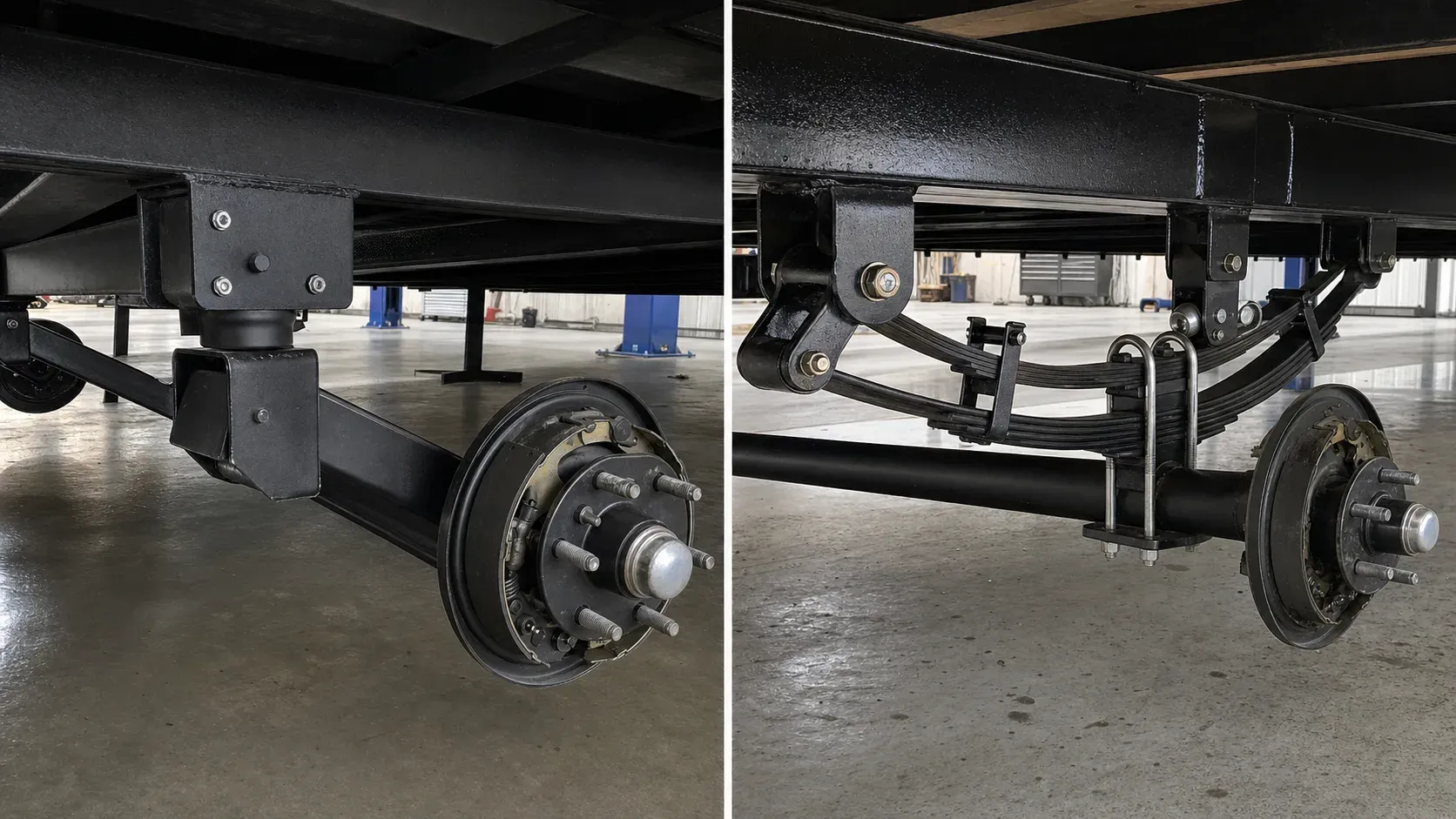
| Leaf Spring | Torsion | |
|---|---|---|
| Ride quality | Firmer, especially empty | Smoother, independent |
| Deck height | The baseline | Lower mounting available |
| Cost | The baseline | The premium |
| Repair | Parts everywhere, rebuildable | Replace the axle |
| Tandem load sharing | Equalizers share bumps | Each axle rides alone |
| Corrosion life | Bushings and shackles wear | Sealed rubber cords |
Both systems live under the axle page's ratings and the suspension page's fundamentals, and neither changes what the trailer carries, only how it carries it.
The rebuildable default
The leaf spring's argument is a century of parts counters. Springs, shackles, bushings, and equalizers are cheap, stocked everywhere, and rebuildable in a driveway. The tandem equalizer does real work too, rocking load between axles so a pothole hits both a little softer, and the suspension fundamentals explain how. Working trailers that live on rough sites take the abuse and take the repair, which is why the equipment and dump worlds run leaves as the default spec.
The downsides are motion and wear. The stack rides firm, an empty trailer skips on washboard, and the shackle-and-bushing chain wears on a schedule your maintenance calendar has to respect.
The smooth and the low
The torsion axle's argument is how the cargo rides. Rubber cords inside the axle tube suspend each wheel independently, with no metal-on-metal stack and no shackle slap, so the motion reaches the deck filtered. That's the reason enclosed cargo, car haulers, and anything hauling vibration-sensitive freight specs it. The low mounting geometry is the second sale, buying the deck-height inches that low-profile builds exist for.
The downsides are the price and the ending. Torsion costs more per axle, each tandem axle carries its own bumps with no equalizer sharing, and when the rubber cords age out, the repair is a whole axle, not a spring kit. Sealed is durable right up until it's terminal.
Duty cycle decides
Name the miles. Rough sites, heavy cycles, and field-repair reality keep leaf springs, the default that every parts counter supports. Pavement miles under cargo that feels vibration, cars, cargo, electronics, tools on shelves, buy torsion's ride, and low-deck designs buy its geometry. Heavy tandems lean leaf for the equalizer's load sharing, which the axle page covers. Either system serves honestly inside its duty cycle, and the only wrong answer is the mismatch.
Torsion vs. leaf FAQ
Which rides better?
Torsion, independently and measurably, especially empty and on patched pavement. The leaf stack firms up loaded and never fully relaxes.
Which lasts longer?
Leaves wear parts on a schedule and rebuild forever. Torsion runs sealed and quiet for years, then gets replaced as a unit when the cords age. Different lifespans, different endings.
Are torsion axles rated lower?
No, both families cover the standard rating tiers. The rating question and the suspension question are separate lines on the spec sheet.
Why do heavy tandems mostly run leaves?
The equalizer shares load between axles on rough ground, and the system repairs in the field. Those match the working world's priorities. Torsion tandems ride each bump alone.
Can I mix the two?
No, match the pair. Mixed systems load unevenly and handle strangely, and no builder specs it.