Deckover Hydraulic Dovetails Explained.

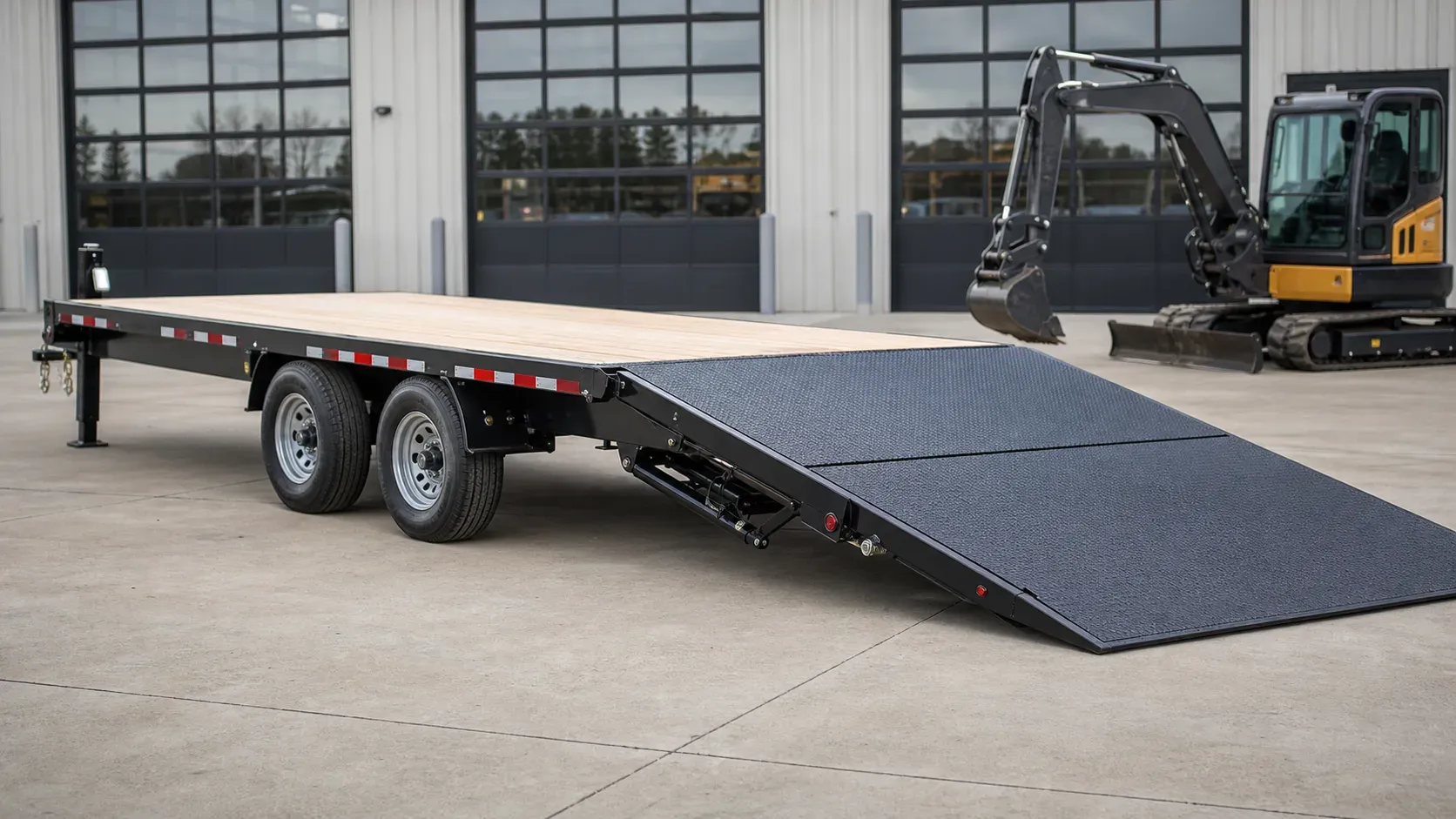
The hydraulic dovetail is the deckover family's answer to its own height. The powered tail folds to the ground, so low, heavy machines board the tall wide deck at a stroll. It's the family's premium loading option and the only one that fully cancels the height tax for driven loads. This page places it in the family. The system's deep coverage lives at /trailers/gooseneck-trailer/hydraulic-dovetail/.
The family solving its own problem
The deckover family's defining trade is width for height, and the hydraulic dovetail buys that height back for driven loads. The tail, the deck's rear 8-to-12 feet, folds to ground contact under hydraulic power. That turns the 32-to-38-inch climb into a 5-to-8-degree stroll, and machines the tall deck would otherwise exclude, like scissor lifts, pavers, and low iron generally, board as if the height were never there.
The family placement is the useful frame. Straight-deck deckovers serve pure forklift freight, since height is irrelevant to forks. Beavertails and flip-over ramps serve the climbers at hinged-steel prices. And the hydrotail serves the loads nothing hinged can accommodate, at the family's steepest option premium. Your machine list writes the choice, exactly as the gooseneck-side guide lays it out.
The configuration lives almost entirely on the gooseneck deckover, because the machines that need flat-tail loading weigh what the neck exists to carry. That's why the deep coverage, cylinders, sequences, locks, maintenance, and the class tables, lives at the gooseneck-side guide this one points to.
What the system does and where it's detailed
Here are the mechanics in one paragraph. The full page has the rest. One or two cylinders drive the tail through its arc on a 12-volt pump and battery, and two-stage designs soften the angle further. Mechanical locks carry the stowed tail on the highway, while hydraulic pressure only ever carries it in motion. The manual backup, a hand pump or bypass, is the walk-around item that separates a working system from a someday-problem.
And the ownership in one more. The premium runs thousands over flip-over ramps, and the hydraulics join the maintenance calendar: fluid, cylinders, battery, hinge-pin grease. The tail's steel taxes payload, and the stowed overhang drags on grade breaks. The deep page itemizes all of it and attaches the buying rule. If your machine list runs under 6 inches of clearance, it writes the check. Otherwise nobody should.
Where the tail sits in the family
| Rear Treatment | Loading Angle | Cost | The Loads |
|---|---|---|---|
| Straight deck | None, forklift only | The baseline | Pure freight |
| Beavertail plus ramps | Hinged-steel angles | Moderate | Climbing machines |
| Hydraulic dovetail | 5 to 8 degrees | The family's steepest | Low, heavy iron |
The class context comes from the gooseneck deckover's tiers, with 22-to-25,900 GVWR as the hydrotail's home range. That tier assumes the dually and license math, and the measurement that actually counts is the flat deck ahead of the hinge, since that's your usable cargo length. The deep page's sizing note covers it.
The tail's family ledger
The buying rule is simple and unchanged. Your machine list decides, and the gooseneck-side guide carries everything that decision needs.
Deckover hydrotail FAQ
What does the hydraulic dovetail solve?
The deckover's own height, for driven loads. The powered tail grounds at 5-to-8 degrees, so low machines board the tall deck without ramps or risk.
Where's the full system coverage?
The gooseneck-side guide, one click deep, covers cylinders, sequences, locks, maintenance, and classes.
Who should skip it?
Forklift freight and climbing machines, as the family's rear-treatment table shows. The premium buys nothing their loads need.
What does it add to ownership?
The hydraulic maintenance calendar, tail steel against payload, and stowed-overhang awareness. The deep page itemizes each one.
Does it exist on bumper-pull deckovers?
Rarely, and only marginally. The machines that need it weigh what the gooseneck classes carry, so in practice it's a gooseneck option.