Low-Profile vs. Standard Dump Trailer. Which One to Buy.

The low-profile dump sits the box closer to the ground. That means easier loading by hand and machine, a lower center of gravity, and cleaner sight lines, and you pay for it in dump angle and a little underbody clearance. The standard dump rides higher, tips steeper, and sheds the sticky loads a low-pro has to coax. Hand loaders and machine loaders lean low-pro. Wet clay and heavy daily volume lean standard.
Low-pro vs. standard at a glance
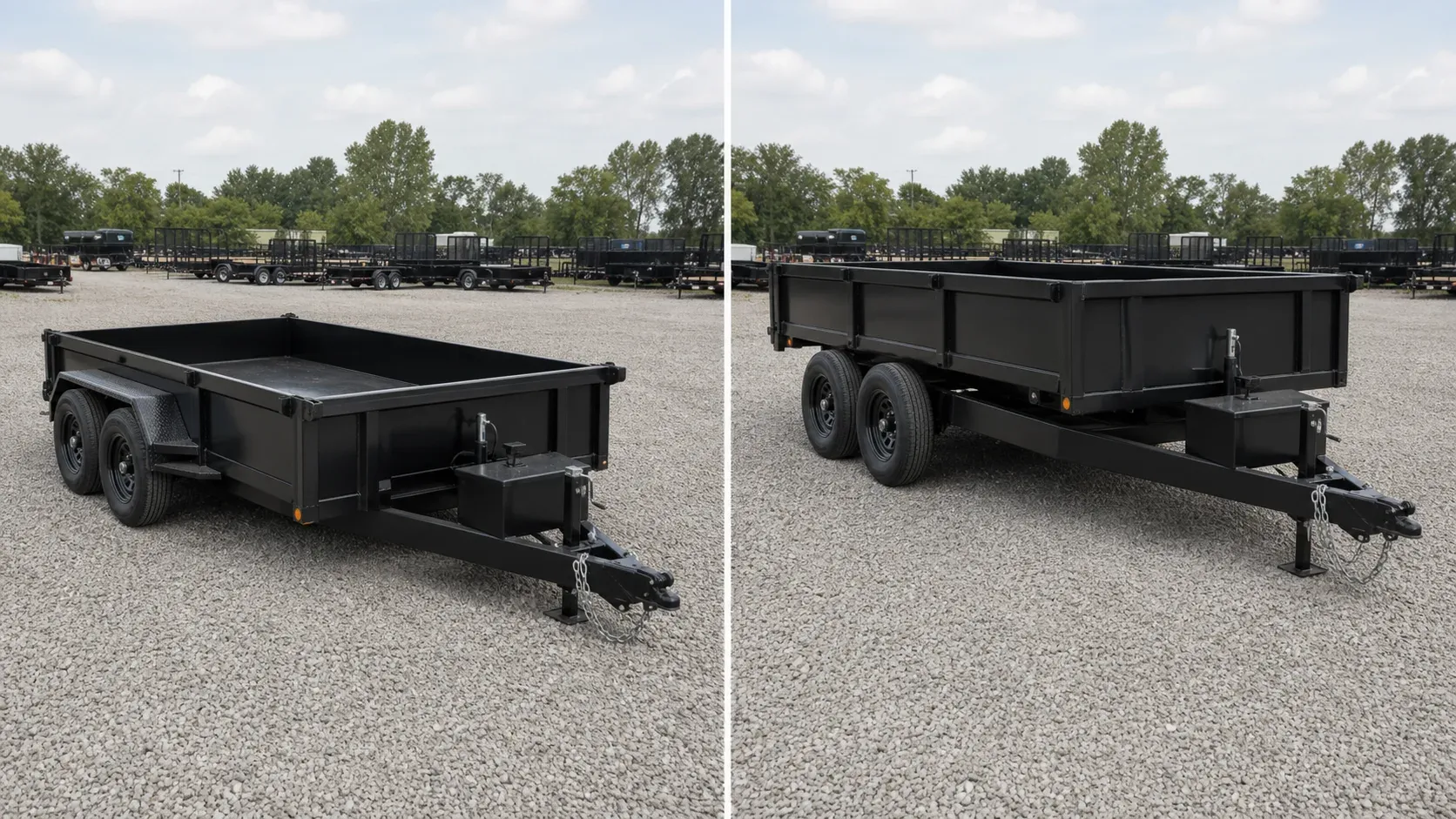
| Low-Profile Dump | Standard Dump | |
|---|---|---|
| Deck height | Lower by 4-to-8 inches | The baseline |
| Loading, hand and machine | Easier every shovel | The height tax |
| Dump angle | Shallower, sticky loads linger | Steeper, sheds clean |
| Center of gravity | Lower, calmer loaded | Higher |
| Ground clearance | Tighter underneath | More margin |
| Price | Comparable to a small premium | The baseline |
Both boxes share the same dump-trailer fundamentals. Hydraulics, gates, and class math don't change, so this is a decision about working geometry, not a different category of trailer.
Loading wins the day
The low-profile build wins on daily motion. Every shovelful clears a lower wall, every skid steer bucket dumps over a shorter side, and the operator can see into the box instead of guessing at it. Those are the ergonomics that decide how a crew feels at four in the afternoon. The lower center of gravity comes free with the design, since a loaded box carries its weight inches lower on the same axles, and you'll appreciate it on every road the class pages send it down.
The downsides are geometric. The shallower dump angle lets wet clay and packed loam cling where a standard box would shed them, and the tucked frame gives up clearance underneath at rough sites. If your material runs sticky, you'll finish the job with a shovel that the cylinder couldn't.
The angle does the work
The standard box wins on the tip. The steeper dump angle sheds everything, wet or dry, on the first cycle, and the extra clearance underneath handles the rutted sites and grade breaks that real material work runs into. As the junk and demo page explains, volume operations run standard boxes because cycle time is revenue, and a load that needs shovel help is a cycle wasted.
The cost is height. You pay it at every hand load and every over-the-side bucket, along with the taller center of gravity the loaded box carries between sites.
The material decides
Start with the material. Dry gravel, mulch, debris, and general loads shed at either angle, so the low-pro's easier loading breaks the tie. Wet clay, packed fill, and sticky loam vote standard every cycle. Hand-loading crews and machine loaders lean toward the low-profile build, volume-first fleets lean standard, and the sizing and class math in the main guide works the same either way.
Low-pro vs. standard FAQ
How much lower is a low-profile dump?
Usually 4 to 8 inches of deck height, achieved with tucked frame rails and axle choices. You feel it at every shovel and bucket.
Does the low-pro dump as well?
For free-flowing material, yes. Sticky loads cling at the shallower angle, which is the trade you made for the lower height, and a shovel settles the rest.
Is capacity different?
Same classes, same payload math. Wall-height options change volume, but the rating doesn't move.
Which is more stable loaded?
The low-pro, by a few inches of center of gravity. That's a real margin on crowned roads and site edges, though both tow fine loaded within their ratings.
Which should a first-time buyer take?
Match it to your material. Mixed and general work leans low-pro for the easier loading, while sticky-material trades lean standard for the angle.