Gooseneck vs. Bumper Pull. We'll Settle This.

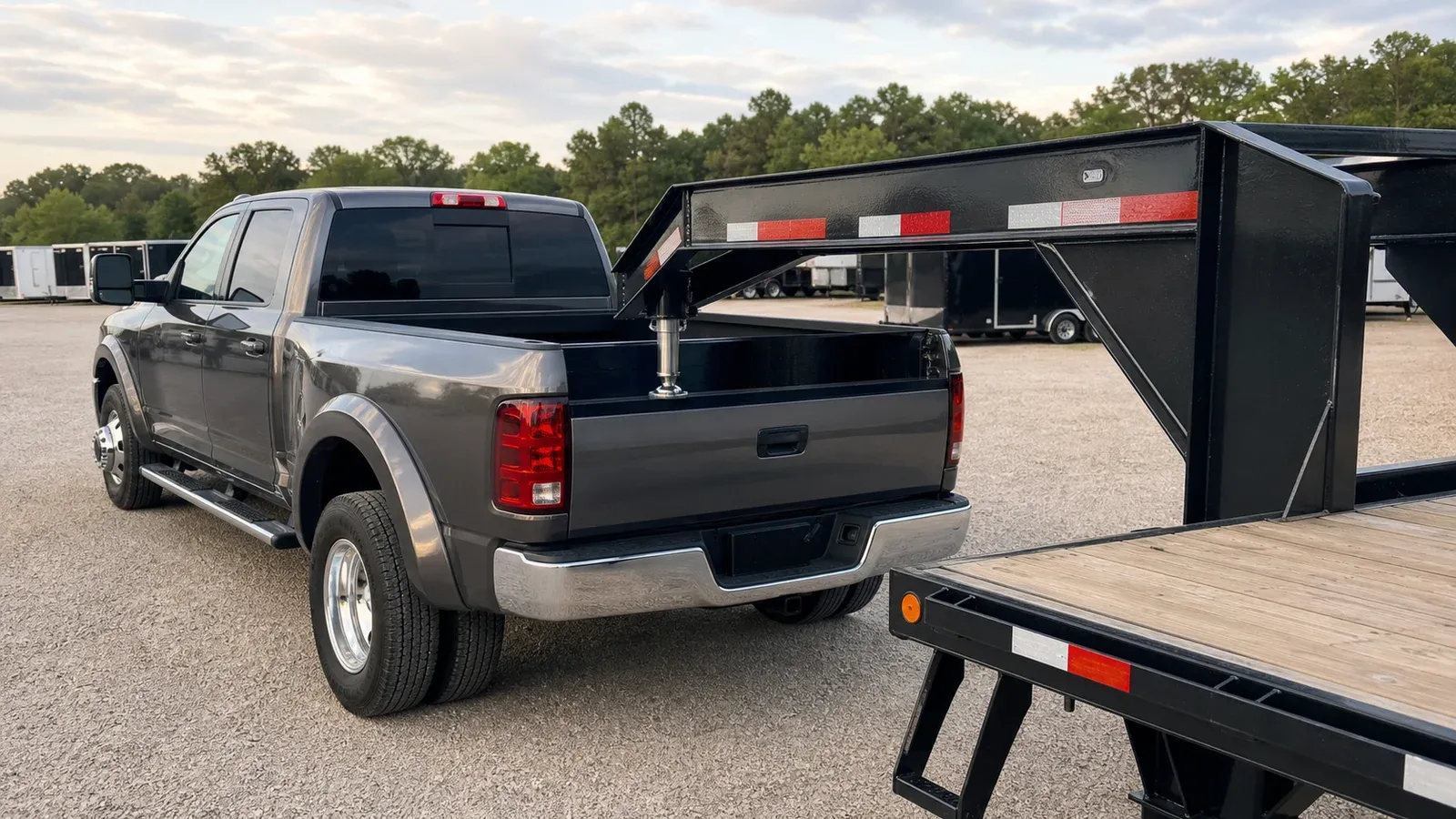
Short answer first. A gooseneck earns its keep when you regularly tow heavy loads, need the stability of an in-bed connection, or maneuver long trailers in tight working spaces. A bumper pull is usually the better buy when the loaded trailer stays comfortably within the truck, receiver, and payload ratings.
The decision is not made at 14,000 pounds by law. That is a useful shopping line because many heavier working trailers move into gooseneck configurations, but the correct answer comes from the exact truck, hitch, trailer, load, and job.
What actually changes
A bumper-pull trailer connects to a receiver behind the truck’s rear bumper. The hitch load acts behind the rear axle, which gives it leverage over the truck. A gooseneck trailer arches over the tailgate and connects to a ball mounted in the bed, usually over or slightly ahead of the rear axle.
Moving the connection forward changes how the combination turns and carries hitch weight. A gooseneck usually tracks with less sway, tolerates a higher pin load, and can turn more sharply. It also needs clearance between the trailer neck, cab, bed rails, and tailgate through the full turn.
Read the gooseneck trailer guide for the complete connection, capacity, and configuration breakdown.
Capacity is more than the tow rating
The truck’s advertised maximum tow rating is only one limit. You also need to check:
- Truck payload from the door-jamb label
- Rear gross axle weight rating
- Gross combined weight rating
- Receiver, ball, coupler, and safety-chain ratings
- Trailer GVWR and actual loaded weight
- Tire and wheel ratings on both vehicles
A gooseneck commonly places 15% to 25% of loaded trailer weight in the bed. A 16,000-pound trailer at 20% pin weight adds about 3,200 pounds to the truck before passengers, tools, fuel, and accessories. That is why some trucks can pull the advertised trailer weight but cannot carry the hitch weight legally or safely.
A bumper pull commonly targets roughly 10% to 15% tongue weight, subject to the manufacturer. The number is smaller, but it still counts against truck payload. Work through payload vs. towing capacity before accepting a salesman’s calculator.
How each one behaves on the road
The gooseneck connection sits closer to the truck’s center of mass. That reduces the lever effect behind the axle and usually makes the combination more resistant to sway. It does not eliminate sway caused by poor loading, low tire pressure, excessive speed, worn suspension, or bad alignment.
A correctly loaded bumper pull can tow very well. Weight-distribution equipment may restore front-axle load and improve control when the truck and hitch manufacturers allow it. It cannot increase the truck’s certified ratings.
The gooseneck also turns differently. It cuts inside the truck’s path and can reach a sharper angle. That helps on jobsites, but it can also put the trailer into a fence, toolbox, cab corner, or tailgate faster than a new operator expects. Practice somewhere inexpensive.
What the gooseneck costs you
The trailer usually costs more than a comparable bumper pull. You also need the correct in-bed hitch, professional installation when required, safety-chain anchors, and a wiring connection that does not drag across the tailgate.
The hitch occupies part of the bed. Turnover-ball and removable systems return much of that space when the trailer is disconnected, but rails, anchors, or a ball may remain. A short-bed truck may need an offset ball or a trailer designed for cab clearance. Never assume clearance from a parking-lot photo.
The truck requirement is often the largest cost. Heavy goosenecks commonly need a properly configured three-quarter-ton, one-ton, or larger truck. Engine output matters, but payload, axle rating, brakes, cooling, wheelbase, tires, and hitch rating decide whether the combination works.
Where a bumper pull wins
A bumper pull works with more tow vehicles, preserves the bed, costs less, and is easier to lend or move between compatible trucks. It is the practical choice for many utility trailers, car haulers, compact equipment trailers, and smaller dump trailers.
It also behaves more predictably for drivers who already understand receiver towing. The connection remains visible behind the truck, hookup does not require backing under a neck, and the trailer cannot contact the cab in a tight turn.
Do not confuse convenient with casual. The receiver must be rated for the load, the ball must match the coupler, the chains must cross and retain the tongue, the breakaway cable must attach independently, and the brake controller must be adjusted for the loaded trailer.
A fair comparison table
| Question | Bumper Pull | Gooseneck |
|---|---|---|
| Typical best fit | Light to medium trailers and flexible truck use | Heavy, long, or frequently worked trailers |
| Connection | Receiver behind rear bumper | Ball mounted in pickup bed |
| Truck-bed use | Fully retained | Partly occupied while hitched |
| Hitch weight | Commonly about 10% to 15% | Commonly about 15% to 25% |
| Maneuvering | Wider path and simpler cab clearance | Tighter turning with more cab and bed clearance checks |
| Stability | Good when matched and loaded correctly | Generally stronger resistance to sway |
| Initial cost | Lower | Higher trailer and hitch cost |
| Truck demands | Broad range, depending on weight | Often heavier-duty truck with substantial payload |
Hoss’ dealer-lot checklist
- Verify the truck’s actual door-jamb payload, not a generic online maximum.
- Get the trailer’s empty weight and projected loaded pin or tongue weight.
- Confirm every hitch component rating in writing.
- Check cab, bed-rail, tailgate, toolbox, and jack clearance on a gooseneck.
- Confirm the trailer plug location and breakaway cable routing.
- Test brakes, lights, coupler lock, jack, and safety-chain attachment.
- Price hitch installation and any bed modifications before comparing totals.
If a dealer says the truck will not know the trailer is back there, the truck is not the one that needs educating.
The honest decision rule
Choose the gooseneck when your measured loads require its capacity, you use the trailer often enough to value its road manners, and your truck has the payload to carry the pin weight. Choose the bumper pull when it handles the real load with reserve and keeping cost, bed access, and truck flexibility matters more.
Do not buy the connection first and invent a job for it later. Match the trailer to the load, then the truck and hitch to the loaded trailer. Our towing and sizing guide gives you the rest of the worksheet.